Concrete Retarders: Types, Uses, Dosage, Benefits & How They Work
Concrete retarders are widely used in modern concrete construction when additional time is needed for transportation, placement, compaction, or finishing.
A concrete retarder is a chemical admixture that delays the setting time of concrete by slowing the early hydration reactions between cement and water. It extends the workable period of fresh concrete without preventing the cement from eventually hardening.
Concrete retarders are particularly useful in hot-weather concreting, mass concrete, long-distance ready-mix transportation, large continuous pours, bridges, dams, tunnels, and complex concrete structures where premature setting could affect placement quality.
Common retarding materials include lignosulfonates, hydroxycarboxylic acids and their salts, phosphates, certain carbohydrates, and formulated retarding admixtures. Sodium gluconate, the sodium salt of gluconic acid, is also widely used as a set-control component in concrete admixture formulations.
Concrete Retarder at a Glance
| Item | Quick Answer |
|---|---|
| What is a concrete retarder? | A chemical admixture used to delay the setting of concrete |
| Main purpose | Extend working, transportation, placement, and finishing time |
| How does it work? | It slows the early hydration reactions between cement and water |
| Common applications | Hot weather, mass concrete, long transport, large continuous pours |
| Common types | Lignosulfonates, hydroxycarboxylates, phosphates, carbohydrates, formulated admixtures |
| Typical dosage | Depends on retarder chemistry, cement, temperature, mix design, and required delay |
| Key benefit | Greater control over concrete setting and placement |
| Main risk | Excessive retardation when overdosed |
| Testing | Laboratory and plant trial mixes are recommended before field use |
What Is a Concrete Retarder?
A concrete retarder, also known as a set retarder or retarding admixture, is an admixture designed to delay the setting of fresh concrete.
After cement is mixed with water, a series of chemical reactions known as cement hydration begins. These reactions gradually transform the fresh mixture from a workable material into hardened concrete.
Under normal conditions, this process provides sufficient time for mixing, transportation, placement, and finishing. However, high temperatures, long transportation distances, large concrete placements, or complicated construction procedures can cause concrete to lose workability or begin setting before the work is completed.
A concrete retarder helps control this process by extending the available working time.
This does not mean that the concrete permanently stops hardening. When properly formulated and dosed, the retarder primarily affects the early hydration and setting process, while normal strength development continues afterward.
How Do Concrete Retarders Work?
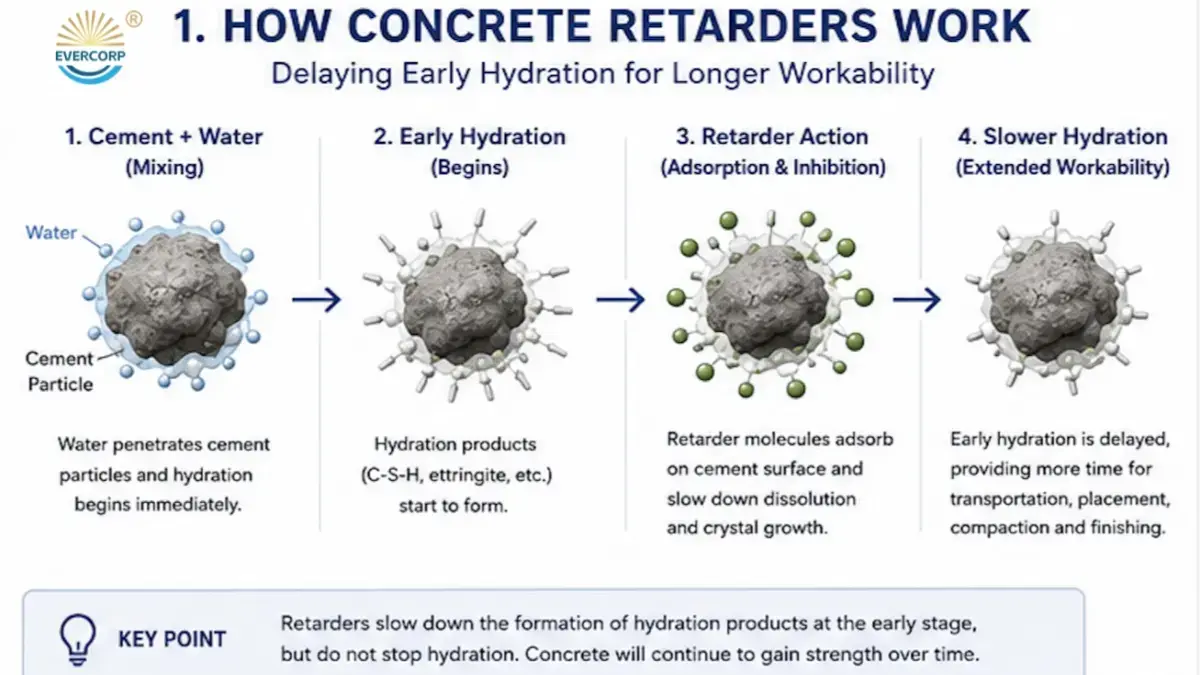
Concrete retarders work by interfering temporarily with the early stages of cement hydration.
When Portland cement comes into contact with water, several cement compounds dissolve and react, eventually forming hydration products such as calcium silicate hydrate (C-S-H), which is primarily responsible for the strength development of hardened concrete.
Depending on their chemistry, retarding compounds can interact with cement hydration through mechanisms such as:
adsorption onto cement particle surfaces;
complexation with calcium ions;
modification of dissolution and precipitation reactions;
temporary inhibition of hydration-product nucleation and growth.
The overall effect is a slower early hydration rate and therefore a longer period before initial and final setting occur.
The degree of retardation is not determined by dosage alone. Cement composition, concrete temperature, supplementary cementitious materials, water-cement ratio, other admixtures, and mixing sequence can all influence performance.
For this reason, trial mixes are essential when a specific setting-time extension is required.
What Are the Main Types of Concrete Retarders?
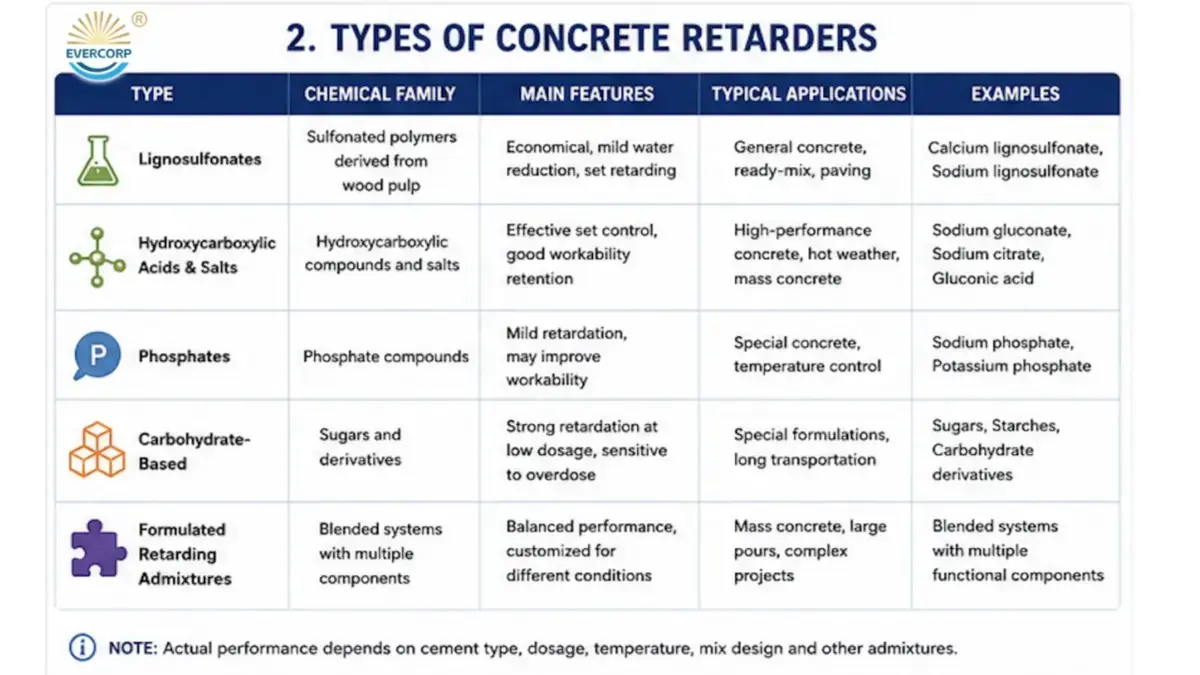
Concrete retarders can be produced from several chemical families. Each behaves differently depending on cement chemistry, dosage, temperature, and the overall concrete formulation.
1. Lignosulfonates
Lignosulfonates are commonly used in traditional concrete admixture formulations and can provide both mild water reduction and setting retardation.
They are widely available and relatively economical, which has made them common ingredients in general-purpose concrete admixtures.
Their actual effect on setting time depends on the product composition, cement characteristics, and dosage.
2. Hydroxycarboxylic Acids and Their Salts
Hydroxycarboxylic compounds are another important group of set-control materials.
This category includes gluconic-acid-based chemistry and related salts.
Sodium gluconate is the sodium salt of gluconic acid and is commonly used as a set-control and chelating component in concrete admixture formulations.
Its interaction with calcium ions and cement surfaces can influence early cement hydration, making it useful in formulations where controlled retardation and workability retention are required.
Performance remains dosage- and cement-dependent, so laboratory evaluation is necessary before commercial application.
3. Phosphates
Certain phosphate compounds can influence cement hydration and may be used as components in specialized retarding systems.
Their performance depends strongly on the formulation and cement system, so they are generally selected according to specific technical requirements rather than treated as universal retarders.
4. Carbohydrate-Based Retarders
Certain sugars and carbohydrate derivatives can strongly affect cement hydration even at relatively low concentrations.
Because small dosage changes may produce significant differences in setting behavior, precise dosage control is particularly important when these materials are used.
Excessive quantities may result in severe or unpredictable retardation.
5. Formulated Retarding Admixtures
Many commercial concrete retarders are not based on a single ingredient.
Instead, manufacturers may combine several functional materials to achieve a target balance between:
setting-time control;
workability retention;
water reduction;
compatibility with cement;
temperature sensitivity;
strength development.
Formulated products are especially useful where concrete performance needs to remain consistent under changing construction conditions.
What Are Concrete Retarders Used For?
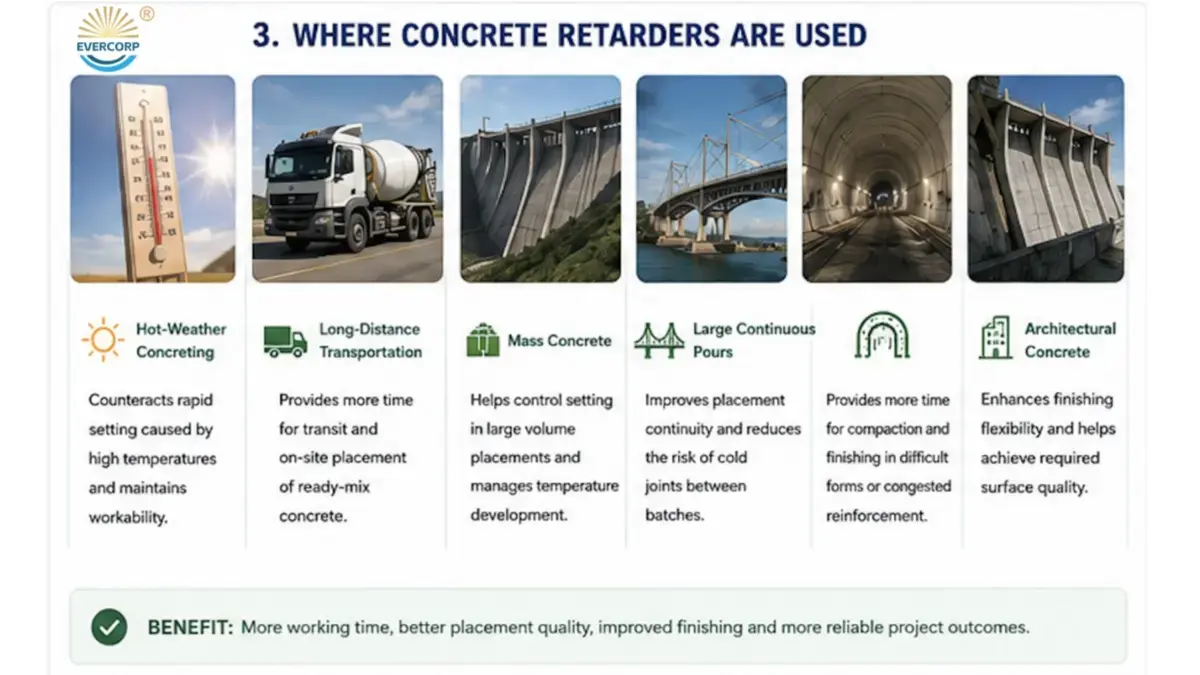
The primary purpose of a concrete retarder is to provide additional working time before the concrete begins to set.
Hot-Weather Concreting
High concrete temperatures can accelerate cement hydration and increase the rate of workability loss.
Retarding admixtures can help extend the available time for transportation, placement, consolidation, and finishing during hot-weather construction.
They are therefore commonly considered for projects in tropical, desert, and high-temperature environments.
Long-Distance Ready-Mix Transportation
Ready-mix concrete may need to travel significant distances between the batching plant and construction site.
Traffic congestion, remote project locations, or complicated unloading procedures can further increase delivery time.
Controlled retardation can provide additional flexibility and reduce the risk of concrete beginning to set prematurely during transportation or placement.
Mass Concrete
Mass concrete structures such as dams, thick foundations, large pile caps, and other large-volume placements require careful control of both construction sequencing and temperature development.
Retarding admixtures can support longer placement windows and help construction teams manage continuous large-volume pours.
However, retarders are only one part of a complete mass-concrete thermal-control strategy.
Large Continuous Pours
Bridge decks, airport pavements, industrial floors, foundations, and other large placements may require multiple concrete trucks to discharge continuously over several hours.
A controlled setting window helps reduce the risk of unwanted construction joints and provides crews with more consistent time for placement and finishing.
Complex Concrete Structures
Concrete with complicated reinforcement, difficult formwork, architectural detailing, or demanding finishing requirements may require additional placement time.
Retarders can provide greater flexibility where normal setting characteristics would make construction difficult.
What Are the Benefits of Concrete Retarders?
When properly selected and dosed, concrete retarders can provide several practical benefits.
Extended Working Time
The most important benefit is additional time for transportation, placement, compaction, and finishing.
Better Hot-Weather Set Control
Retarders can help compensate for accelerated setting caused by elevated concrete temperatures.
Improved Placement Continuity
For large pours, longer working time can make it easier to coordinate multiple batches and maintain continuity between successive concrete deliveries.
Greater Finishing Flexibility
Additional working time gives construction crews more opportunity to complete screeding, leveling, texturing, and other finishing operations.
Support for Complex Construction
Projects involving difficult access, dense reinforcement, complicated formwork, or extended pumping distances may benefit from additional placement time.
It is important, however, to distinguish these benefits from guaranteed performance improvements. A retarder must be properly matched with the cement and overall mix design to achieve the intended result.
How Much Concrete Retarder Should Be Used?
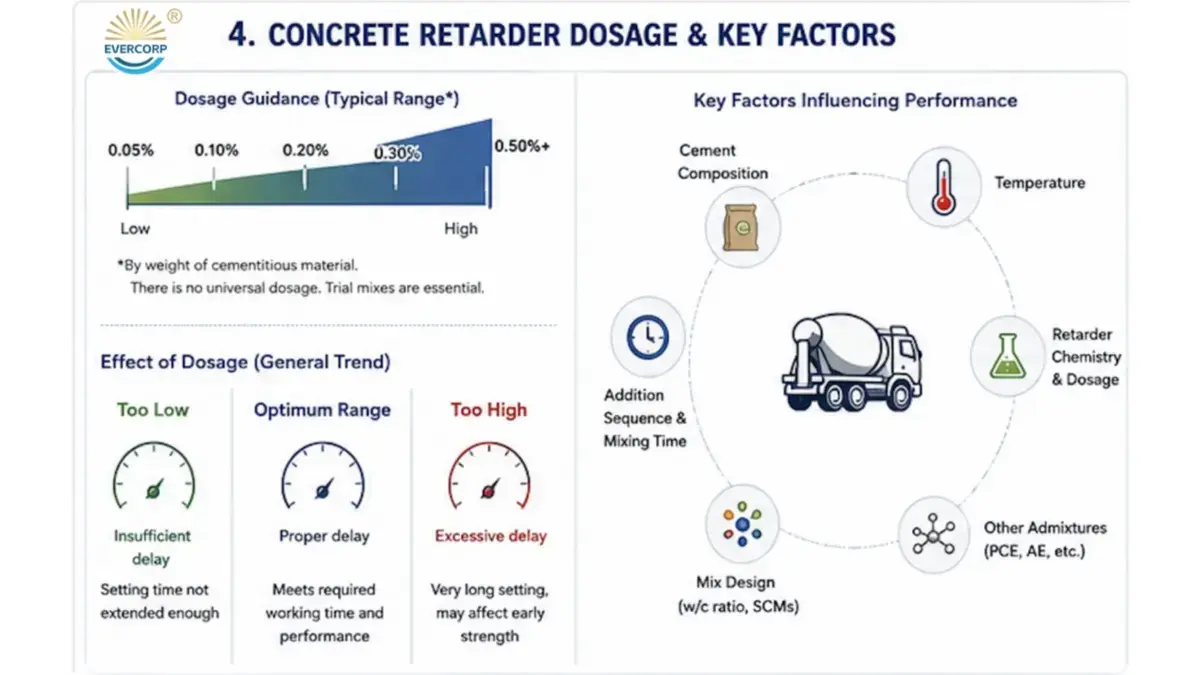
There is no universal dosage for concrete retarders.
The optimum dosage depends on several factors, including:
| Factor | Why It Matters |
|---|---|
| Retarder chemistry | Different chemical families have different dose-response behavior |
| Cement composition | Cement mineralogy and sulfate balance can affect retardation |
| Concrete temperature | Temperature strongly influences hydration and setting |
| Supplementary cementitious materials | Fly ash, slag, silica fume, and other SCMs may change setting behavior |
| Water-cement ratio | Mix composition influences hydration and admixture response |
| Other admixtures | PCEs, air entrainers, accelerators, and other additives may interact |
| Required delay | Longer transportation or placement windows may require different set-control strategies |
| Addition sequence | When and how the admixture is introduced can influence performance |
Increasing retarder dosage generally increases the setting delay within an appropriate working range, but the relationship should not be assumed to be perfectly linear.
Excessive dosage may cause very long setting delays and may adversely affect early-age performance.
For commercial concrete production, the recommended procedure is to establish dosage through laboratory trial mixes followed by plant-scale verification under representative job-site conditions.
What Factors Affect Concrete Retarder Performance?
Two concrete mixtures containing the same retarder at the same dosage can behave differently.
Important variables include:
Cement Chemistry
Different cement sources can have different clinker mineral compositions, sulfate levels, fineness, and supplementary materials.
These differences can significantly affect the response to a retarding admixture.
Temperature
Temperature is one of the most important variables affecting concrete setting.
A formulation developed at 20°C should not automatically be expected to provide exactly the same setting-time extension at 35°C.
Supplementary Cementitious Materials
Fly ash, ground granulated blast-furnace slag, silica fume, limestone powder, and other supplementary materials can influence hydration behavior and admixture demand.
Water-Reducing Admixtures
Modern concrete frequently contains both set-control agents and high-range water reducers.
Their interaction should be evaluated as part of the complete concrete formulation rather than testing each ingredient in isolation.
Mixing and Addition Sequence
The point at which the retarder is introduced during batching can influence dispersion and interaction with cement.
Consistent batching procedures are therefore important for repeatable performance.
Concrete Retarder vs. Surface Retarder: What's the Difference?
A concrete retarding admixture and a surface retarder are not the same product, even though both delay cement hydration.
| Feature | Concrete Retarding Admixture | Surface Retarder |
|---|---|---|
| Application | Added into the concrete mix | Applied to the concrete surface or formwork |
| Effect | Influences the bulk concrete | Primarily delays hydration at the surface |
| Main purpose | Extend setting and working time | Produce exposed-aggregate or textured surfaces |
| Common use | Ready-mix, mass concrete, hot-weather pours | Architectural and decorative concrete |
A conventional retarding admixture is distributed throughout the concrete.
A surface retarder, by contrast, is applied to selected surfaces. It temporarily delays hardening of the surface cement paste so that the outer paste can later be removed to expose the aggregate underneath.
Concrete Retarder vs. Water Reducer vs. Superplasticizer
Concrete retarders are also sometimes confused with water reducers and superplasticizers.
Their primary functions are different.
| Admixture | Primary Function | Typical Effect on Setting | Main Objective |
|---|---|---|---|
| Concrete retarder | Delay setting | Retards | Extend working time |
| Water reducer | Reduce required mixing water | Depends on chemistry | Improve workability or strength |
| Superplasticizer | Provide high-range water reduction | Depends on formulation | High flow and/or low water-cement ratio |
| Retarding water reducer | Water reduction + retardation | Retards | Combine workability and extended set |
A product may perform more than one function.
For example, ASTM C494/C494M Type D admixtures combine water reduction with retardation.
Can Concrete Retarders Be Used with PCE Superplasticizers?
Yes, retarders can be used in concrete containing polycarboxylate ether (PCE) superplasticizers, but compatibility should be verified through testing.
Polycarboxylate ether (PCE) is a high-range water-reducing polymer widely used in modern concrete to improve flowability and reduce water demand.
When a PCE superplasticizer and a retarding component are used together, several variables can affect performance:
PCE molecular structure;
retarder chemistry;
cement composition;
dosage;
temperature;
addition sequence;
supplementary cementitious materials.
The combination may influence both slump retention and setting behavior.
For high-performance concrete, self-compacting concrete, precast formulations, and long-slump-retention systems, compatibility testing should therefore be performed using the actual cement and materials intended for the project.
Concrete Retarder Standards and Testing
Concrete admixtures should be evaluated according to applicable national or project-specific standards.
ASTM C494/C494M
ASTM C494/C494M is a widely used specification covering performance requirements for chemical admixtures for concrete.
Relevant classifications include:
Type B — Retarding
Type D — Water-Reducing and Retarding
The appropriate classification depends on the functions and performance of the admixture.
EN 934-2
For many European and international projects, EN 934-2 provides requirements for admixtures used in concrete.
Project specifications may also establish additional requirements depending on structural design, exposure conditions, and local regulations.
Setting-Time Testing
Setting behavior can be evaluated using standardized test procedures such as ASTM C403/C403M, which determines the time of setting of concrete mixtures by penetration resistance.
Compressive-Strength Testing
Hardened concrete performance can be evaluated through compressive-strength testing, such as ASTM C39/C39M, where applicable.
Compliance should always be assessed against the relevant standard, project specification, and approved concrete mix design.
How to Choose the Right Concrete Retarder
Selecting a retarder should be based on the concrete system and construction conditions rather than product price alone.
Consider the following factors.
1. Required Setting-Time Extension
Determine how much additional working time is actually needed for transportation, pumping, placement, and finishing.
2. Concrete Temperature
Consider both batching temperature and expected site conditions.
3. Cement and SCM Compatibility
Test the retarder with the actual cement, fly ash, slag, or other cementitious materials used in production.
4. Compatibility with Other Admixtures
If the mix contains PCE superplasticizers, air-entraining agents, viscosity modifiers, or other admixtures, evaluate the complete admixture system.
5. Concrete Performance Requirements
Do not evaluate setting time alone.
Workability, slump retention, air content, early strength, later-age strength, and durability requirements may also need to be considered.
6. Technical Documentation
For international procurement, request relevant technical documentation such as:
Technical Data Sheet (TDS)
Safety Data Sheet (SDS)
Certificate of Analysis (COA)
product specification;
recommended storage conditions;
packaging information;
regulatory or quality documentation where applicable.
7. Trial Samples
For concrete admixture raw materials, laboratory samples allow formulators to evaluate compatibility with local cement and other raw materials before commercial purchasing.
Common Problems When Using Concrete Retarders
Excessive Retardation
Overdosing can result in significantly delayed initial and final setting.
The severity depends on the retarder chemistry, dosage, cement, and temperature.
Insufficient Retardation
If the dosage is too low for the actual temperature or transportation conditions, the required working-time extension may not be achieved.
Cement Compatibility Problems
Changing cement suppliers without repeating compatibility tests can produce unexpected changes in setting behavior.
Interaction with Other Admixtures
Retarders should not be evaluated independently when they are used in complex admixture systems.
Inconsistent Batching
Variations in dosage accuracy or addition sequence can contribute to inconsistent field performance.
For these reasons, concrete producers should maintain appropriate quality-control procedures and verify significant formulation changes through testing.
Storage, Handling and Safety
Storage requirements vary by product chemistry and physical form.
Always follow the manufacturer's TDS and SDS for specific storage and handling instructions.
General good practice includes:
storing the material in its original or suitable compatible container;
protecting the product from contamination;
observing recommended storage temperatures;
using appropriate personal protective equipment;
avoiding uncontrolled discharge into soil or waterways;
following applicable local regulations for handling and disposal.
Shelf life should not be generalized across all concrete retarders. Refer to the individual product specification for the recommended storage period.
Frequently Asked Questions About Concrete Retarders
What is a concrete retarder?
A concrete retarder is a chemical admixture that delays the setting of concrete by slowing early cement hydration. It provides additional time for transportation, placement, compaction, and finishing.
How does a concrete retarder work?
Retarders interact with cement particles, dissolved ions, or early hydration products and temporarily slow the reactions responsible for concrete setting. The exact mechanism depends on the chemistry of the retarding agent.
What are the main types of concrete retarders?
Common categories include lignosulfonates, hydroxycarboxylic acids and their salts, phosphates, certain carbohydrates, and formulated commercial retarding admixtures.
Is sodium gluconate a concrete retarder?
Sodium gluconate is widely used as a set-control component in concrete admixture formulations. Its interaction with cement hydration can provide retardation and contribute to workability-control systems. Actual performance depends on dosage, cement chemistry, temperature, and the complete admixture formulation.
Does a concrete retarder reduce concrete strength?
Not necessarily. A properly selected and dosed retarder is intended to delay setting while allowing the concrete to develop its required hardened properties. Excessive dosage or an incompatible mix design, however, can affect early-age performance, which is why trial testing is important.
How much concrete retarder should be used?
There is no universal dosage. The appropriate amount depends on the retarder chemistry, cement, temperature, mix design, other admixtures, and required setting-time extension. Laboratory trial mixes should be used to determine the appropriate dosage.
What happens if too much concrete retarder is added?
Excessive dosage can cause very long setting delays and may affect early strength development. The concrete should be evaluated according to appropriate quality-control and testing procedures rather than assuming that it will perform normally.
Can concrete retarders be used with PCE superplasticizers?
Yes, but compatibility testing is recommended. PCE structure, retarder chemistry, cement composition, dosage, temperature, and addition sequence can all influence slump retention and setting behavior.
What is the difference between a concrete retarder and a surface retarder?
A concrete retarding admixture is mixed throughout the concrete to delay bulk setting. A surface retarder is applied to the surface or formwork and primarily delays the surface paste, usually for exposed-aggregate finishes.
When should a concrete retarder be used?
Concrete retarders are commonly considered for hot-weather concreting, long-distance ready-mix transportation, mass concrete, large continuous pours, complex structures, and projects requiring additional placement or finishing time.
Looking for Concrete Retarder Raw Materials?
EverStar Group supplies chemical raw materials for concrete admixture manufacturers, ready-mix producers, construction chemical formulators, and international distributors.
For concrete set-control Applications, we supply sodium gluconate and related concrete admixture raw materials for customers developing retarding, water-reducing, and workability-control formulations.
Technical and commercial information can be provided according to product and project requirements, including:
TDS
SDS
COA
Product samples
Technical specifications
Packaging options
Export documentation
If you are evaluating sodium gluconate or other raw materials for a concrete admixture formulation, EverStar Group can support product selection based on your required specification, application, packaging, and shipment requirements.
Contact EverStar Group: info@cneverstar.com
Request a sample or quotation to evaluate the material with your local cement and admixture formulation.
References
1. ASTM International. ASTM C494/C494M — Standard Specification for Chemical Admixtures for Concrete.
2. ASTM International. ASTM C403/C403M — Standard Test Method for Time of Setting of Concrete Mixtures by Penetration Resistance.
3. ASTM International. ASTM C39/C39M — Standard Test Method for Compressive Strength of Cylindrical Concrete Specimens.
4. European Committee for Standardization. EN 934-2 — Admixtures for Concrete, Mortar and Grout — Concrete Admixtures.
5. ACI Committee 212. Report on Chemical Admixtures for Concrete.
6. Ramachandran, V. S. Concrete Admixtures Handbook: Properties, Science, and Technology.
7. Mindess, S., Young, J. F., and Darwin, D. Concrete.