BLOG List
What is Concrete Set Retarder and How Does It Work?
A concrete set retarder is a special kind of chemical that slows down the process of cement hydration. This makes it possible to work with concrete for longer before it hardens. Retarders help builders have more control over placement and finishing by slowing down the chemical processes that cause setting. This is especially important during complicated pours, hot weather, or long-haul transportation. This longer workability window stops cold joints, lowers the risk of thermal cracking in mass concrete, and makes sure that big projects all have the same finish on the surface.
Understanding Concrete Set Retarders: Definition and Mechanism
A concrete set retarder works by getting in the way of the early processes that happen when cement hydrates, especially those involving tricalcium silicate (C₃S) and tricalcium aluminate (C₃A). When these additives are mixed into concrete, they stick to the cement particles and make a brief barrier that slows the release of calcium ions and the formation of calcium silicate hydrate (C-S-H) gel, which is what holds concrete together when it hardens.
Chemical Composition and Active Ingredients
There are three groups of chemicals that most Set Retarders come from. Lignosulfonates, which come from grinding wood pulp, are a cheap way to slow down the building process. Hydroxycarboxylic acids, such as citric and tartaric acids, let you precisely control how long something takes to set and are often used in concrete Applications. A third type is sodium gluconate (CAS 527-07-1), which is a bio-based polyhydroxycarboxylate made by fermenting glucose. This white crystalline powder has a linear, reliable set-controlling effect and doesn't cause flash-sets at any dose. This makes it especially useful for hot-weather concreting where thermal acceleration is a problem.
How Retarders Interact with Cement Hydration
Retarders make the dormant phase last longer before the acceleration phase starts during the induction stage of cement drying. This wait time lets the concrete stay flexible for a longer time, usually an extra two to four hours, based on the amount used and the weather. The process involves attracting calcium ions and building complexes with early hydration products. This stops the growth of C-S-H crystals for a short time. It's important to note that this delayed hydration often leads to higher long-term compressive strength when used at the suggested doses. This is because the slower reaction makes the microstructure more regular and thick.
Types and Advantages of Concrete Set Retarders
There are different types of concrete set retarders used in the building business, and each one is made for a specific job and set of performance needs. When buying managers know these differences, they can better match goods to project needs while also getting the best quality and value for money.
Natural vs. Synthetic Retarders
Some natural slowing agents are refined sugars and lignosulfonate products. They provide mild slowing at low costs. For normal ready-mix jobs where exact time is not as important, these materials work well. Synthetic retarders, like phosphates and gluconates, offer more consistent performance and more accurate doses. For example, sodium gluconate is very good at chelating iron at an alkaline pH of 10–13, so it can be used as both a set retarder and an industrial chelating agent. Because it can be used in so many ways, it's a star product in the water treatment, building, and commercial cleaning industries.
Surface-Applied vs. Integral Admixtures
Surface retarders are put on formwork or concrete surfaces to keep the top layer from setting too quickly. This lets the gravel finishes show through. Integral admixtures are added right into the concrete batch, so they slow down the pour evenly throughout. Integral goods, like sodium gluconate, keep the same quality over large amounts. This lowers variation and ensures reliable performance in important building projects like airport runways and dam foundations.
Key Performance Advantages
Using retarders has more benefits than just extending time. They keep the previous layer bondable when the next lift is put down, which stops cold joints from forming in straight pours. In buildings made of mass concrete, retarders lower the peak heat of hydration. This lowers the thermal differences that cause cracks. Extended transport windows are good for ready-mix makers because they let their products get to rural places or through crowded cities without affecting their ability to work. The surface finishes are better because workers have enough time to trowel, texture, and apply the drying product before it starts to set.
How to Use Concrete Set Retarder Effectively in Construction Projects
Pay close attention to the amount of concrete set retarder you use, how you mix it, and the surroundings when you're doing it. If procurement managers know about these technology issues, they can choose goods that work well with current processes and avoid common problems.
Dosage Guidelines and Mixing Protocols
The usual dose is between 0.2% and 0.5% of the cement's weight, but this can change depending on the temperature, the type of cement, and the length of time you want the delay to last. To stop heat growth, higher temperatures need higher doses. To make sure that the high-purity sodium gluconate (≥98.0% purity) is spread out evenly in the mix, exact mixing equipment is needed. The additive should never be put on dry cement; it should be added to the mixing water or mixed in during the building process. If you use too much, it can cause delays that last for days, but if you keep the concrete wet, it will finally set and reach its original strength.
Application Scenarios and Case Studies
Retarders are used to control the heat of hydration in mass concrete projects like building dams and raft supports that are more than two meters thick. In these situations, delayed setting lets the core temperature drop slowly, which stops delayed ettringite formation and thermal cracks. Long-haul ready-mix companies that work on building projects in rural areas use retarders to keep the mix pumpable after more than 90 minutes of travel. Surface retarders are used in decorative architectural concrete to make visible gravel finishes. The final surface's aesthetic quality depends on how well the timing is done.
Safety and Compliance Considerations
Individuals handling sodium gluconate need to wear normal safety gear like gloves and safety glasses, even though it is not as harmful as other chelators. To avoid caking, storage should take place in cool, dry places that are away from moisture. The product doesn't contain any chloride (≤0.05% chloride content), so there are no risks of reinforcing rusting. It meets the standards set by ASTM C494 Type B and EN 934-2. Sodium gluconate is easy to deal with because it breaks down naturally. According to OECD 301E testing procedures, it breaks down over 90% in 28 days.
Choosing the Right Concrete Set Retarder for Your Projects
To choose the best concrete set retarder, you have to weigh technical performance, legal compliance, supply chain stability, and the total cost of ownership. For B2B buyers to find solutions that meet both short-term project needs and long-term planning goals, they have to look at a lot of different factors.
Technical Performance Criteria
Modern concrete mixes must be compatible with polycarboxylate superplasticizers because many projects need both high flowability and long workability. The polyhydroxycarboxylate structure of sodium gluconate makes sure that it works well with PCE mixtures without interfering with them. It can be used with different types of cement, including high-volume fly ash (HVFA) concrete, because the 10% solution has a pH range of 6.2 to 7.8. However, doses must be carefully adjusted because fly ash already slows down the curing process. Products should have linear set delay curves that let engineers accurately predict setting times even when temperatures change.
Certification and Quality Assurance
For global building projects to work, the materials used must meet a number of worldwide standards. For food-grade uses, high-quality goods have approvals like FCC (IV), BP, and USP. For construction-grade uses, they have REACH, HALAL, KOSHER, and ISO 9001. Third-party testing by SGS and Intertek makes sure that requirements like heavy metal content (≤10 ppm Pb), sulfate levels (≤0.05%), and reducing chemicals (≤0.5%) are met. These licenses are very important for companies that buy things from the government and work with Fortune 500 companies like CEMEX and BASF.
Supply Chain and Procurement Strategy
When compared to distributor markups, factory-direct prices from dependable sources cut costs by 20–40%, which is a big deal for big projects that need hundreds of tons of admixture. The minimum order quantity of about five tons strikes a good mix between ease of access and savings of scale. Standard goods should ship within three days, and personalized formulas made for local aggregates or high-sulfate coastal areas should arrive within five to seven business days. Lead times are very important for building plans. Being close to ports lowers the cost of shipping, and technology support teams that speak multiple languages make sure that everyone can understand each other across global operations.
Sustainability and Environmental Responsibility
Biodegradable alternatives to chelators like EDTA and NTA are given top priority by buying plans that are on the cutting edge. The bio-based source of sodium gluconate from glucose fermentation is in line with green building efforts and LEED certification standards. Suppliers who agree to reduce carbon emissions by a certain percentage by 2030 are in line with ESG business standards that are becoming more and more important to institutional owners. Because it can be used as both a concrete retarder and an industrial chelating agent, it makes it possible for multiple departments to buy in bulk, which streamlines supply chains and lets companies take advantage of big savings.
Optimizing Concrete Performance with Set Retarders: Best Practices
To get the most out of retarding admixtures, you need to know how they work with other parts of the mix and how new technologies will change the way building is done in the future. Integrating a concrete set retarder into your formulation strategy ensures stability during complex placements.
Synergistic Formulation Strategies
When you mix retarders with other admixtures, you can make concrete with qualities that are exactly what the engineering needs. When retarders are mixed with air-entraining agents, the resistance to freeze-thaw is better in cold places, and the workability stays the same during placement. Water-reducing retarders (ASTM C494 Type D) do both. They lower the amount of water to cement while also making the setting time longer. This makes them perfect for high-strength jobs that need low leakage. Because sodium gluconate is so good at chelating iron, it keeps white concrete mixes from turning colors when they come into contact with iron-rich materials or groundwater.
Hot Weather Concreting Protocols
When the temperature outside is higher than 30°C (86°F), soaking happens much faster, which can cause the material to stiffen before it's fully cured. Protocols that work well in hot weather include pre-cooling the materials, using chilled mixing water, and increasing the amount of retarder by 0.1 to 0.2 percent for every 5°C rise in temperature above 20°C. The straight performance curve of sodium gluconate gets rid of flash-set risks even at high doses, giving you safety gaps in case field conditions are worse than you thought. Continuous tracking with maturity meters helps keep track of the rate of water and make dynamic changes to placement plans.
Emerging Technologies and Innovations
Smart admixtures with IoT-enabled sensors claim to let you watch how concrete sets in real time and let the mix and site management tools talk to each other wirelessly. These new ideas will make it possible to predictably change the amount of retarder needed based on real temperature patterns instead of guesses. New retarders that use nanotechnology are being made so that molecular-level water rates can be controlled even more precisely. People who work in procurement who keep in touch with innovative sources get early access to new technologies. This gives them an edge when taking on difficult projects with strict quality standards.
Conclusion
By understanding how concrete set retarders work and choosing the right goods, you can turn difficult building problems into tasks that you can handle. Delays make materials easier to work with for longer, stop them from cracking when heated, allow them to be shipped over long distances, and make the surface better in a wide range of situations. Sodium gluconate is a great example of current additive technology because it is bio-based, has multiple uses, and performs consistently while being very environmentally friendly. When purchasing managers put an emphasis on high-purity formulations, thorough approvals, and reliable supply lines, their companies are better prepared to complete large-scale building projects while keeping costs low and environmental goals in mind.
FAQ
Does using a set retarder reduce final concrete strength?
No, when dosed properly, delayed concrete usually has the same or higher 28-day compressive strength as mixes that haven't been fixed. The slower drying process makes the crystal structure more organized and have fewer empty spaces, which makes it last longer. Studies have shown that properly delayed concrete can become 5–10% stronger because the particles are better packed together and there is less microcracking.
How do I determine the correct dosage for my project?
How much to use varies on the temperature of the area, the type of cement, how long of a wait is wanted, and how well it works with other ingredients. Starting points are usually between 0.2 and 0.5 percent by weight of the cement. These can be changed up or down depending on the weather or the use of other cementitious materials. The most accurate way to figure out the dose is to do test batches with local materials and cement. Reliable sellers offer free samples and expert help to make sure that formulations are as good as they can be before they are made on a big scale.
Are eco-friendly retarders as effective as traditional options?
Modern bio-based concrete set retarders, such as sodium gluconate, work as well as or better than manufactured alternatives. They also have better environmental effects. These materials meet both scientific and environmental standards because they break down over 90% in 28 days and don't leave behind any harmful chemicals. Adopting this chelator is financially appealing because it saves 20–40% on costs compared to competing chelators without lowering quality.
Partner with EverStar Group for High-Performance Concrete Set Retarder Solutions
EverStar Group is ready to help you with your building projects by providing high-quality sodium gluconate concrete set retarder and 14 years of experience in the field. With Our Factory-direct supply model, you can connect directly with factories in Southern, Eastern, and Northern China. This cuts out the middlemen and saves you 20–40% on costs compared to other ways of buying things. We work with clients from over 50 countries, such as CEMEX, BASF, and big government building programs. Our track record on difficult projects gives you peace of mind.
Our expert team is available 24/7 to help in multiple languages, create OEM/ODM formulations, and give you free samples so you can test their compatibility with your local rocks. Full certificates like ASTM C494, EN 934, HALAL, KOSHER, REACH, and FDA compliance make sure that the product is accepted by regulators in all places around the world. We can handle both pilot projects and large-scale continuous supply deals because the minimum order size is only five tons and shipping is within three to seven days. As a company that makes concrete set retarders that cares about green science and carbon neutrality, we put 5% of our annual income into research and development to make sure that your projects are always on the cutting edge of technology. Get in touch with info@cneverstar.com right away to talk about your unique needs and get personalized formulation suggestions from our tech team.
References
1. Mindess, S., Young, J.F., and Darwin, D. (2003). Concrete: Structure, Properties, and Materials, 2nd Edition. Pearson Education.
2. Ramachandran, V.S. (1995). Concrete Admixtures Handbook: Properties, Science and Technology, 2nd Edition. William Andrew Publishing.
3. American Society for Testing and Materials. (2017). ASTM C494/C494M-17: Standard Specification for Chemical Admixtures for Concrete. ASTM International.
4. Neville, A.M. and Brooks, J.J. (2010). Concrete Technology, 2nd Edition. Pearson Education Limited.
5. Taylor, H.F.W. (1997). Cement Chemistry, 2nd Edition. Thomas Telford Publishing.
6. European Committee for Standardization. (2009). EN 934-2: Admixtures for Concrete, Mortar, and Grout - Part 2: Concrete Admixtures. CEN Brussels.
Concrete Retarder Chemical Explained: Functions and Benefits
Controlling the setting time of concrete becomes a very important engineering problem when planning big building projects or high-temperature concrete pours. As a special additive, a concrete retarder chemical slows down the hydration of the cement. This makes the concrete easier to work with while keeping its ultimate power. Flash-setting risks, cold joint formation, and slump loss during transport are all issues that ready-mix plants, infrastructure builders, and precast makers all over the United States have to deal with. This technology directly fixes these issues. Procurement managers and technical experts can cut down on material waste, speed up projects, and make sure structures stay strong in tough building sites by knowing how these additives work and choosing the right formulation.
What Is a Concrete Retarder Chemical, and How Does It Work?
Set delay additives work by slowing down the initial stages of cement's main hydration phases, especially the fast reactions of C3S (tricalcium silicate) and C3A (tricalcium aluminate). These chemicals make a barrier around the cement particles that stops water from getting to them briefly and slows down the exothermic process that makes the cement harden. This makes the plastic last longer, which gives finishers more time to place, harden, and treat the surface.
Chemical Composition and Mechanism
Hydroxycarboxylic acids are often the main factor in modern retardation solutions. Our sodium gluconate-based concrete retarder chemical solution is a typical example of this technology. It has a set delay curve that stays the same for 2–4 hours at a dose of 0.1% in temperatures between 30°C and 35°C. This bio-based compound is better than earlier lignosulfonate or sugar-based alternatives because it has linear, dose-responsive performance that has been proven by isothermal calorimetry testing. This means that engineers can safely change the dosage without experiencing unpredictable acceleration or lasting strength loss.
The molecule stops the formation of calcium silicate hydrate crystals for a short time by attracting and holding calcium ions at the cement-water contact. Normal hydration starts up again after a few hours of the protective effect wearing off, often making a harder crystalline material than unretarded mixes. This is the reason why properly mixed retarded concrete often has higher 28-day compression strengths, which goes against the popular belief that delayed setting makes concrete less durable.
Performance Parameters and Technical Specifications
Set control chemicals of high quality must meet strict requirements. Our technical-grade recipe is a white, crystalline powder that is ≥98.0% pure. It keeps the chloride content below 0.05% to keep the reinforcements from rusting, which is an important requirement for building projects that are meant to last 50–100 years. A 10% solution has a pH between 6.2 and 7.8, which means it can be mixed with current polycarboxylate ether superplasticizers that are often used in high-performance concrete.
Some important scientific benefits are that it dissolves in water more than 99% of the time, which means that it spreads evenly even in low-water concrete mixes, and it loses less than 0.5% of its original weight when it dries, which means that it will work the same way in all humidity levels. Heavy metal content stays below 10 parts per million for lead, which supports both food-grade and building uses where strict compliance with regulations is required.
Types and Applications of Concrete Retarder Chemicals
Set retardation technology is used in the building business in two different ways. Each one meets the needs of a different job and provides different benefits to contractors and ready-mix producers.
Admixture-Type Retarders for Mass Concrete
Admixture-type concrete retarder chemical products control hydration across the entire mix when added at the batching plant. This method is necessary for placing large amounts of concrete that are thicker than 1 cubic meter, like dam foundations, bridge beams, or raft slabs. The longer setting window controls the heat of hydration to stop thermal cracking. This lets repeated lifts bond chemically instead of making weak cold joints.
Infrastructure workers who work on airport runways and tunnel linings like how flexible this is for their planning. A normal workability window of 90 minutes can be extended to 4–6 hours to account for things like traffic jams, broken equipment, and the difficulties of coordinating work on urban building sites. The technology also cuts down on the need for emergency concrete rejection, which wastes material and causes delays that cost projects $500 to $2,000 per cubic yard.
Surface Retarders for Exposed Aggregate Finishes
Formulations that are added to the surface only slow down the top 3–8 mm of the concrete skin. The rest of the mixture is left to set normally. Once the inside is strong enough, workers pressure-wash the layer that has been delayed, revealing the artistic aggregate needed for architectural concrete, textured sidewalks, or bridge deck overlays that need to mechanically connect with later pours.
This two-step process solves a long-standing problem in the production of precast concrete: form change rates need to be balanced with standards for good looks. When compared to mechanical abrasion methods, this method lets producers strip forms on time while still getting the desired surface roughness. This increases facility output by 20–30%.
Application Across Environmental Conditions
In southern states like Texas, Arizona, and Florida, where it gets hot, careful control of the delay is needed for hot-weather concreting. When temperatures are outside of 30°C or higher, the rate of evaporation can cause the material to tighten before it has fully consolidated. Our sodium gluconate version is more stable at high temperatures than lignosulfonate alternatives. It keeps working as well at retarding growth without having to keep increasing the dose in a way that costs a lot and raises the risk of overdose.
On the other hand, products that will be used in cold weather below 10°C need lower doses or different mixtures of accelerators. We give our technical support teams region-specific dosing tools that take into account the type of cement (Type I/II Portland, blended cements with fly ash or slag), the temperature of the rock, and the strength gain needs of the project. This ability to customize has been especially useful for EPC companies in North America who are in charge of projects with different climates.
Comparing Concrete Retarder Chemicals: Choosing the Best Fit for Your Project
Buying things depends on knowing what makes one performance different from another and how that affects both short-term usability and long-term structure results. Not all retardation technologies work the same way, and choosing goods that aren't the best can throw off project timelines and costs.
Performance Benchmarks and Compatibility
For building admixtures to work, they need to be predictable, which means that setting times can be accurately predicted even when site conditions change. Our special recipe does this with a dose-response relationship that is linear. This means that for every 0.05% increase in dosage, the benefits last for an extra 60 minutes without stopping all of a sudden. This is very different from sugar-based retarders, which can behave in a way that isn't linear, which can cause either not enough delay or terrible extended-set scenarios.
Economic and Environmental Considerations
Another important review factor is how well the product works with other cementitious materials. Adding fly ash or silica dust to a mix changes how it works compared to systems that only use Portland cement. We use ASTM C403 penetration resistance methods to test each client's cement source and SCM blend to make sure they are compatible. This way, we can give mix design engineers proven performance data instead of vague product claims.
The full cost of ownership includes more than just the purchase price. It also includes dosage rates, shipping costs, and environmental compliance. If you compare the performance of our bio-based sodium gluconate solution to manufactured options like EDTA or NTA, it saves you 20–40% on costs. The molecule's 60–70% smaller carbon footprint meets the standards for LEED v4.1 credits and companies' ESG promises, which are becoming more important for infrastructure projects that the government pays for.
Eco-Friendly Solutions and Industry Trends
Because the product has both food-grade and technical-grade Certifications (FCC, USP, BP, HALAL, KOSHER), distributors can serve both the building and food/pharma markets. This makes inventory management easier and lowers the minimum order number requirements. This flexibility has been especially helpful for chemical wholesalers that want to improve their ties with suppliers and make the buying process more efficient.
Sustainability-focused purchasing teams now give more weight to recipes that break down quickly and meet OECD 301E standards. Our answer breaks down over 90% within 28 days, supporting EU Ecolabel and Nordic Swan certifications for environmentally conscious requirements. This is different from older retarders made of phosphates, which stay in the groundwater and pose a risk of eutrophication in areas that are sensitive to building sites.
Procurement Insights: How to Buy Concrete Retarder Chemical for Industrial Use
When looking for set retardation additives strategically, you need to find a balance between technical performance, supply chain stability, and total landing cost. This is especially important for companies that manage multiple project sites or a lot of material each year.
Supplier Evaluation Criteria
Certifications for production are the first step in figuring out credibility. Our production facilities are ISO 22000 and FSSC 22000 approved, and we use statistical process control and strict quality assurance methods to make sure that each batch is the same. A Certificate of Analysis (COA) is included with every package. It lists 18 quality factors, such as purity, chloride level, heavy metal limits, and pH stability.
Regional access has a big effect on how projects are scheduled. With three carefully placed factories in the Southern, Eastern, and Northern production zones and an inventory of more than 500 metric tons, we can promise shipping times of 7 to 10 days across the entire United States. This infrastructure gets rid of the 4–6 week delays that come with only using foreign sources. This keeps expensive projects from being halted when demand suddenly rises.
Minimum Order Quantities and Pricing Models
We know that the amount of concrete additive used changes a lot depending on when a job is started and how much demand changes with the seasons. The usual minimum order number of 5 tons works for both medium-sized ready-mix businesses and big infrastructure builders without making them pay too much to keep inventory on hand. Bulk tanker transport choices (20–25 tons) offer extra savings for customers who buy a lot, while 25 kg bags and intermediate bulk containers (IBCs) help precast producers who need a lot of different product SKUs.
Comparing Technical Support and After-Sales Service
With factory-direct pricing, there are no markups for distributors, which usually raise prices by 20–40%. This directly addresses the buying pain point of middle-man costs. Volume commitment price tiers reward yearly purchase agreements while keeping flexibility through quarterly true-up provisions that adjust for real consumption. This structure is especially valued by EPC firms whose demand patterns are based on projects.
More than just delivering products is needed to optimize the success of a mixture. Our 24/7 international technical support team helps with mix design calculations, making dose changes on-site, and fixing problems that happen when the set doesn't act the way it should. We offer free samples (5–10 kg) for trial batch confirmation with our customers' local aggregates and cement sources. This is an important service because the chemistry of raw materials can vary from place to place, which can affect how well an admixture works.
Concrete Retarder Chemical Safety, Shelf Life, and Best Practices
When admixtures are used on an industrial scale, they need to be stored and handled in a way that protects both worker health and product performance throughout the supply chain.
Handling Protocols and Worker Protection
Compared to other formulations, sodium gluconate-based concrete retarder chemical products pose the lowest handling risk. Because it is a solid powder, it doesn't corrode like liquid acids do, and its near-neutral pH (6.2–7.8 in solution) keeps your skin and eyes from getting irritated like alkaline additives do. Personal safety equipment suggestions include standard dust masks for handling bags and gloves for long-term skin contact. Batching plant workers already know these rules.
Storage Conditions and Shelf Life Management
The steps for containing a spill are the same as those for other dry chemical additions. Because the product dissolves easily in water, mistakes can be cleaned up and used again if they are not contaminated. This cuts down on material loss. The environment doesn't get affected much because the chemicals break down quickly. However, big spills near waterways should be contained according to normal chemical handling procedures to avoid pH changes in the area.
With proper storage, a product can last for 24 to 36 months before it stops working. For storage, temperatures must stay between 5°C and 35°C and relative humidity must stay below 65% to stop moisture absorption that can lead to caking. We suggest putting no more than five bags high on a pallet (using 25 kg packaging) and rotating your collection once a month to make sure the oldest items run out first.
Impact on Curing Duration and Long-Term Durability
Cement dust and other particles from the mixing machine can't get into sealed containers. After being opened, bags should be closed again or the contents should be moved to carriers that won't get wet. Quality control tests, which can be as easy as checking the pH and purity of the product with standard lab tools, can confirm that the product is still good for use even though it is getting old. However, proper keeping usually keeps the product fully compliant with all specifications for the entire shelf life.
A common technical problem can be solved by figuring out the connection between retardation and power growth. The final soaking process takes the same amount of time as unretarded concrete, but the initial setting process takes an extra two to four hours at normal doses. Seven-day strengths usually hit 70–75% of 28-day values, which is enough for most structural uses that need early form removal or post-tensioning.
Conclusion
When you master set delay technology, putting down concrete stops being a race against time and becomes a controlled, quality-focused process. Sodium gluconate-based concrete retarder chemical admixtures combine performance reliability, environmental responsibility, and cost efficiency.They solve the main problems that procurement managers, technical experts, and project schedulers have all at the same time. This chemistry is perfect for building builders, ready-mix makers, and precast manufacturers who have to deal with projects that get more complicated because it has predictable retardation curves, works with current concrete systems, and can be certified in two different ways. Companies can get rid of the quality problems and supply problems that threaten project success by working with providers who offer technical-grade manufacturing standards, quick shipping, and full support services.
FAQ
Does excessive dosage permanently prevent concrete from hardening?
If you severely overdose, the plastic stage can last for several days, but as long as the concrete stays wet, it will finally reach its full strength. According to research, delayed hydration often leads to thicker microstructures that have higher final compressive strengths than control mixes.
Can retarders be combined with superplasticizers in the same mix?
It works well with polycarboxylate ether superplasticizers, but test batches should be made to make sure that the right mix keeps the appropriate slump retention and setting patterns. Some versions have synergistic benefits, which means that less of both admixtures is needed.
How does ambient temperature affect dosing requirements?
There is an exponential link between temperature and retardation. For every 10°C rise in concrete temperature, the rate of moisture doubles. Dosage changes of 0.03–0.05% per 5°C keep the working time the same on sites with different conditions. However, the exact needs rely on how the cement reacts and the project requirements.
Partner with EverStar Group for Reliable Concrete Retarder Chemical Supply
EverStar Group has been making admixtures for 14 years and can help buying teams find a reliable concrete retarder chemical source. Pharmaceutical-grade sodium gluconate that is ≥98% pure is made in facilities that are ISO 22000 approved. These facilities also meet the requirements of ASTM C494, EN 934, FDA, HALAL, and KOSHER. We keep more than 500 metric tons of inventory in carefully placed plants near major ports. This lets us send standard orders in three days and make special formulations that work with the cement chemistry or high-sulfate coastal environments in your area in five to seven days.
Our OEM/ODM services go beyond just supplying products; our expert teams offer free sample testing with your local aggregates, 24/7 help in multiple languages, on-site training, and full documentation sets with mixing tools and usage videos. You can place an order for as little as 5 tons, and you can choose from different types of packing, such as 25 kg bags, IBCs, and bulk tankers. If you buy directly from the plant, you can save 20–40% compared to buying through distributors. Email info@cneverstar.com to get samples or talk about how our bio-based, easily recyclable retarder product can help you make your next infrastructure project better while also helping you meet your sustainability goals.
References
1. Ramachandran, V.S., Concrete Admixtures Handbook: Properties, Science, and Technology, Second Edition, Noyes Publications, 1995.
2. Kosmatka, S.H., Kerkhoff, B., and Panarese, W.C., Design and Control of Concrete Mixtures, 14th Edition, Portland Cement Association, 2008.
3. Neville, A.M., Properties of Concrete, Fifth Edition, Pearson Education Limited, 2011.
4. ASTM C494 / C494M-19, Standard Specification for Chemical Admixtures for Concrete, ASTM International, West Conshohocken, PA, 2019.
5. ACI Committee 212, Report on Chemical Admixtures for Concrete (ACI 212.3R-16), American Concrete Institute, Farmington Hills, MI, 2016.
6. Jolicoeur, C. and Simard, M.A., Chemical Admixture-Cement Interactions: Phenomenology and Physico-Chemical Concepts, Cement and Concrete Composites, Vol. 20, 1998.
Concrete Retarders: Their Uses, Mechanism & Pros
Concrete retarders are special chemical additives that slow down the hydration process in cementitious materials. This keeps the concrete workable for longer and stops it from setting too quickly. These extras are now necessary for modern building, especially for big infrastructure projects that need to be put in place over a long period of time. These admixtures slow down the initial and final setting phases without affecting the long-term structural integrity. This lets contractors handle complex pours in tough conditions, such as on hot summer highways or in intricate architectural finishes that need exact timing and perfect execution.
What Are Concrete Retarders and How Do They Work?
Defining Retarding Admixtures in Modern Construction
Retarding admixtures are a group of chemical molecules that are made to stop the early processes that cause cement to harden. These agents extend the induction period, which is important because it's during this time that new concrete is still malleable and easy to work with. The process involves sticking to the surfaces of cement particles and creating obstacles that stop water and cement from interacting for a short time. This controlled delay stops the formation of calcium silicate hydrate crystals during important placing stages. This gives enough time for consolidation, finishing, and shipping without lowering the structure's final compressive strength.
Chemical Composition and Hydration Interaction
Hydroxycarboxylic acids, lignosulfonates, or phosphate-based chemicals are used in most recipes. The current retarder profile is shown by sodium gluconate, a common example of concrete retarders, a white solid powder that is ≥98.0% pure and has the CAS number 527-07-1. It slows down the setting of concrete for 2 to 7 hours in a way that can be predicted using a dose-response graph that is between 0.05% and 0.15% by weight. This gets rid of the flash-set risks that came with older options based on citric acid or sugar. The 10% solution has a pH range of 6.2–7.8, which makes it compatible with Portland cement chemistry. It also has a low chloride level (≤0.05%), which keeps reinforcing steel from rusting, which is an important factor for the long-term durability of infrastructure.
Practical Application Methods for Site Teams
To use concrete retarders, they need to be carefully mixed into the concrete at the mixing plant or an on-site mixer. As part of quality control, ASTM C403 testing protocols must be followed. These methods measure setting time by entry resistance. Engineers figure out amounts by looking at the temperature, the type of cement, and how long the wait needs to be. To make sure that high-performance mixes with Polycarboxylate Ether (PCE) superplasticizers are compatible, test runs must be made to make sure the rheological stability. Documentation like Certificates of Analysis (COA), Safety Data Sheets (SDS), and Technical Data Sheets (TDS) helps with buying choices by making sure that product specs match project needs and foreign standards for compliance.
Types of Concrete Retarders and Their Best Use Cases
Natural versus Synthetic Formulations
Traditional natural concrete retarders come from refined wood sugars and lignosulfonates, and they work well and don't cost much for everyday use. Synthetic substitutes, such as sodium gluconate, are more consistent and reliable. The second one has technical-grade requirements, such as a loss on drying of less than 0.5%, a sulfate content of less than 0.05%, and heavy metals (Pb) of less than 10 ppm. These requirements make sure that each batch is the same, which is important for quality control in large-scale projects. Synthetic formulas are also more stable when temperatures change, which is why ready-mix manufacturers that serve a wide range of geographic areas where weather changes a lot during building seasons choose them.
Climate-Specific Selection Strategies
For hot-weather concreting in temperatures above 35°C, a strong retarder is needed to slow down the faster rates of drainage and hydration. Specialized formulas keep the workability even after long travel from batching facilities to remote job sites, which stops cold joints from forming in continuous placements. On the other hand, uses that are used in moderate climates may use smaller dosage rates to get shorter delays that work with normal ending plans. Coastal projects that are exposed to high levels of sulfate benefit from formulations that are more resistant to salt and work well with extra cementitious materials like fly ash or slag, which make the structure last longer against harsh climatic conditions.
Compatibility with Cement Types and Mix Designs
Businesses that make ready-mixed concrete need retarders that work with different types of Portland cement, such as Type I/II general-purpose and Type V sulfate-resistant types. When making precast, manufacturers focus on adding ingredients that keep the shape stable during demolding processes. When mass concrete is used in dams or bridge piers, it needs to be mixed in a way that controls the heat of hydration and stops thermal cracking through controlled exothermic reaction rates. Knowing these differences helps purchasing managers choose goods that meet the performance standards of a specific project. This is made possible by technical support teams from manufacturers who offer advice on mix design optimization and on-site training for quality control staff.
Benefits of Using Concrete Retarders in Global Construction Projects
Using concrete retarders and other set-controlling additives in a planned way changes the costs and structure of a project. Longer workability windows keep labor costs low by keeping crews from working extra hours on complicated pours that need continuous placement operations. Enhanced consolidation gets rid of honeycombing and gaps, which makes the finished surface look better and increases the density of the structure. When looked at across big infrastructure projects, these operational benefits add up to real cost saves.
Workability Extension and Cold Joint Prevention
Contractors can put down repeated concrete lifts within critical bonding windows when setting is delayed. This gets rid of weak planes that weaken the structure's integrity. This is very helpful for tall parts like retaining walls or slipform paving, where quality results depend on progress being kept up. EverStar Group's sodium gluconate-based formulas have been used in projects that have reported consistent 3–5 hour workability extensions at 0.10% dosage rates. This allows for smooth finishing across large placements while keeping slump retention, which makes pumping and consolidating operations easier.
Durability Enhancements and Strength Development
When hydration happens more slowly, microstructures become thicker, more regular, and less permeable. This makes it more resistant to chloride attack, sulfate attack, and freeze-thaw cycling, all of which are important factors that determine how long infrastructure will last in sea or deicing salt settings. Lab tests show that retarders that are properly dosed have 28-day compressive values that are higher than 110% of control mixes. This meets the performance standards of ASTM C494 Type B. The resulting buildings are more durable over time, which means they require less upkeep and cost less over their entire life.
Environmental and Sustainability Considerations
Biodegradability traits in modern concrete retarder formulations meet the needs of rising environmental concerns. Products that meet the OECD 301E guidelines biodegrade at least 90% within 28 days, which means they have little to no effect on the environment when they are washed away or accidentally released. Fe³⁺ chelation is better than traditional chelators like EDTA at neutral pH levels (>11), which helps clean up production processes. These traits are in line with what is needed to get LEED certification and with companies' ESG promises. This is especially important for developers who want to get green building recognition or follow the rules in places where the project will affect the environment.
How to Choose the Right Concrete Retarder for Your Project
Project-Specific Performance Criteria
The first step in selecting concrete retarders is figuring out how long the setting delay needs to be based on the placement details and the environment. Engineers set goal slump retention times, end strength benchmarks, and how well the material works with admixture packages that contain water reducers and agents that trap air. Teams in charge of buying things look at certificates from suppliers, like FCC, USP, BP, HALAL, KOSHER, and ISO 9001, to make sure they follow the rules in all foreign markets. Independent testing labs like SGS and Intertek give performance data to well-known makers. This backs up claims with third-party proof that helps with due diligence.
Supplier Reliability and Supply Chain Stability
For infrastructure projects to go smoothly, materials must flow continuously and in time with building plans. Delays that cost a lot of money can be avoided by checking out suppliers' production capabilities, inventory management systems, and transportation networks. With plants ideally placed near major ports and a yearly capacity of more than 50,000 tons, EverStar Group makes sure that there is a steady supply of bulk goods. Standard goods are shipped within three days, and formulas that are made to fit the chemistry of the aggregate or the high sulfate conditions in the area are sent within five to seven days. This responsiveness, along with expert help available 24 hours a day, seven days a week in multiple languages, solves the sourcing problems that foreign contractors and EPC companies working on complicated, time-sensitive projects have.
Cost-Benefit Analysis for Procurement Decisions
With factory-direct pricing, there are no markups for middlemen, so prices are 20–40% lower than through standard routes of distribution. This economic benefit grows when a lot of goods are bought at once, like when building projects need thousands of tons. Procurement managers weigh unit costs against performance predictability and prefer providers with free sample programs that let them try compatibility with local aggregates before placing large orders. Starting at five tons, the minimum order quantity can be met by both large-scale projects and regional distributors building up their stock. Clear price systems make budgeting and keeping track of costs easier throughout the lifespan of a project.
Best Practices for Using and Applying Concrete Retarders
Dosage Calculations and Mixing Protocols
To get an accurate dosage, you need to figure out the amount of filler as a percentage of the cement mass. This is usually between 0.1% and 0.5% by weight of cementitious materials (BWOC). Trial mixes at the site determine the best rates by taking into account the temperature, how the cement reacts, and the time that needs to be allowed. Additives should never be added straight to dry cement. Instead, they should be added during filling or after the first mixing. A regular spread is ensured by mixing the ingredients for at least 90 seconds after they are added. Quality control teams keep an eye on slump loss over time and write down the results so that dosing can be improved for future runs and consistency is maintained across places that last more than one day.
Avoiding Common Application Pitfalls
Overdosing is the most common mistake, which can make setting times last longer or permanently fail, which will need expensive repairs. Such results can be avoided by following the manufacturer's instructions and doing entry resistance tests according to ASTM C403. When older lignosulfonate types are mixed with PCE superplasticizers, they may not work well together. This can lead to segregation or air void instability. Problematic interactions are found during pre-qualification testing before they are used in the field. Conditions of storage are important. Liquid mixtures need to be kept in frost-free, UV-protected areas that stay between 5 and 35°C so that chemicals don't break down and change how well they work.
Safety and Regulatory Compliance
Standard workplace chemical handling methods include wearing eye protection and gloves and making sure there is enough airflow during batching operations. Safety Data Sheets list how to give first aid and clean up a mess. Products that meet FDA, REACH, and regional legal standards help make sure that foreign projects are completed correctly. Environmental management includes keeping waste water in one place and getting rid of it in a way that follows local rules. Regular training for workers of batching plants and field teams keeps safety standards high and makes sure that the right methods are used. Tracking batch tickets, dosage records, and quality test results with documentation systems creates audit trails that help ISO 9001 quality management systems and project specification compliance checks.
Conclusion
Set-controlling admixtures such as concrete retarders have become essential tools for modern building, making it possible to build complicated structures that would not be possible or affordable otherwise. Today's recipes are very complex technically. For example, sodium gluconate-based goods have linear dose-response curves and can be used in many industries. This is the result of decades of progress in chemical engineering. It's helpful for procurement workers to understand these differences so they can choose providers who offer large-scale production, technical know-how, and responsive service methods. As the world's needs for infrastructure grow and people become more concerned about sustainability, it's more important than ever to find partners you can trust who can offer consistent quality, the ability to customize, and full support for the duration of the project.
FAQ
Does retardation reduce final concrete strength?
When used in the right amounts, good retarding additives keep or improve the 28-day compression strength. The slower hydration process makes the crystal structures more regular, which usually leads to 110–115% of the control mix strength required by ASTM C494. At 7, 28, and 90 days, strength tests show performance trends that back the assumptions made during the design phase.
What recovery options exist after accidental overdosing?
When someone overdoses very badly, they need expert help. Options include letting it cure longer at a controlled temperature and humidity level, adding admixtures that speed up the process to make up for the delay, or, in the worst cases, removing and replacing the material. Decisions are based on continuous tracking through security testing. Prevention through correct mixing and training of operators is still the best way to go about things.
How do I verify compatibility with my cement supplier?
Ask for tests of a sample batch using the cement type, materials, and full admixture package that you want to use. As directed by ASTM C403, try the slump retention every 30 minutes for four hours and record the setting time. When using air-entraining products, compare how stable the air content is. Technical representatives from reputable companies are available to help with these tests for free.
Partner with EverStar Group for Reliable Concrete Retarder Supply
We know how hard it is for buying managers to find reliable, high-performance admixtures that meet the exact needs of a project. EverStar Group has been making things for 14 years and has a lot of certificates, such as ASTM C494, EN 934, REACH, HALAL, and KOSHER. They have clients in more than 50 countries, including Fortune 500 companies and leaders in their fields. Our sodium gluconate products work as expected, and because they come from the plant, you can save 20–40% compared to buying from other companies. Email our team at info@cneverstar.com to get free samples that will work with your materials, talk about OEM/ODM customization for specific uses, or look into choices for buying in bulk starting at five tons. Visit everstargroup.cn to access technical documentation and mixing calculators and connect with multilingual support teams ready to help you make the best decisions about your concrete admixture plan.
References
1. Ramachandran, V.S., Malhotra, V.M., Jolicoeur, C., and Spiratos, N. (1998). Superplasticizers: Properties and Applications in Concrete. Ottawa: CANMET.
2. Dodson, V.H. (1990). Concrete Admixtures. New York: Van Nostrand Reinhold.
3. Rixom, R. and Mailvaganam, N. (1999). Chemical Admixtures for Concrete. London: E & FN Spon.
4. American Society for Testing and Materials (2020). ASTM C494: Standard Specification for Chemical Admixtures for Concrete. West Conshohocken: ASTM International.
5. Neville, A.M. and Brooks, J.J. (2010). Concrete Technology. Essex: Pearson Education Limited.
6. Aitcin, P.C. (2016). Science and Technology of Concrete Admixtures. Cambridge: Woodhead Publishing.
PCE vs Naphthalene Superplasticizer: Which Water Reducer Should You Choose?
Polycarboxylate ether (PCE) and sulfonated naphthalene formaldehyde (SNF), also called naphthalene superplasticizer or PNS, are two widely used high-range water-reducing technologies for concrete.
Both can improve concrete flowability while reducing the amount of mixing water required.
However, their molecular structures, dosage requirements, slump-retention behavior, formulation flexibility and cost structures are different.
So which one should a concrete producer choose?
The practical answer is:
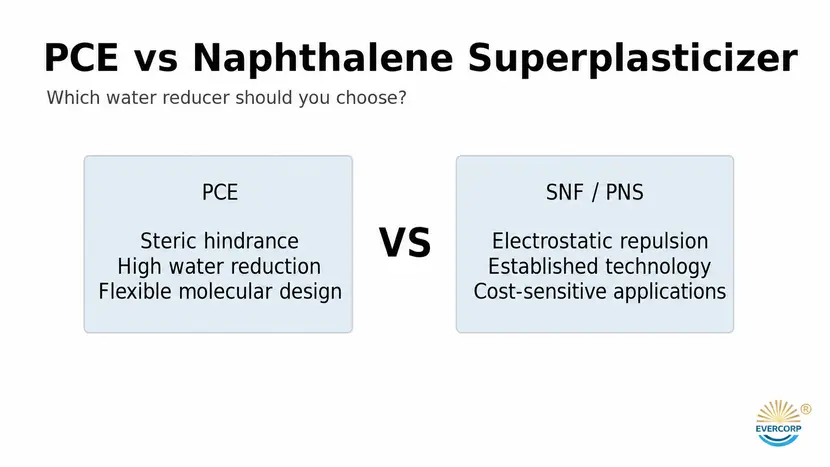
PCE is generally preferred when high water reduction, low water-to-binder ratio, extended workability or high-performance concrete is required. SNF remains a practical option for many conventional and cost-sensitive concrete Applications where extremely high water reduction or long slump retention is not required.
The correct choice should be based on the total concrete performance and cost per cubic meter rather than admixture price per ton alone.
What Is PCE Superplasticizer?
Polycarboxylate ether superplasticizer is a comb-shaped polymer.
Its molecular structure normally contains:
· an adsorption-active backbone; and
· long hydrophilic polyether side chains.
Once the polymer adsorbs on cement particles, the side chains extend into the aqueous phase and create steric hindrance.
This makes it difficult for dispersed cement particles to come back together.
The result is efficient cement dispersion and the release of water previously trapped inside cement agglomerates.
Because PCE structure can be deliberately modified, manufacturers can design different grades for:
· high water reduction;
· slump retention;
· precast concrete;
· self-compacting concrete;
· low-viscosity concrete;
· specific cement compatibility.
What Is Naphthalene Superplasticizer?
Naphthalene superplasticizer is commonly based on sulfonated naphthalene formaldehyde condensate.
It is also referred to as:
· SNF;
· NSF;
· PNS;
· naphthalene-based superplasticizer.
SNF works mainly through electrostatic repulsion.
After adsorption onto cement particles, negatively charged sulfonate groups increase repulsive forces between particles.
This breaks down cement agglomerates and improves flowability.
SNF has been used for decades and remains an established water-reducing technology in many markets.
PCE vs SNF: Quick Comparison
|
Performance Factor |
PCE Superplasticizer |
Naphthalene/SNF Superplasticizer |
|
Main dispersion mechanism |
Steric hindrance + electrostatic effects |
Mainly electrostatic repulsion |
|
Typical water reduction |
Generally higher |
Moderate to high |
|
Required dosage |
Generally lower on active basis |
Generally higher |
|
Slump retention |
Can be specifically designed for long retention |
Generally shorter without formulation support |
|
Molecular design flexibility |
Very high |
More limited |
|
High-performance concrete |
Excellent suitability |
Possible, but less efficient in demanding systems |
|
SCC/UHPC |
Commonly preferred |
Less commonly selected |
|
Cement sensitivity |
Can be sensitive to sulfate, clay and cement chemistry |
Different compatibility profile |
|
Raw-material cost per ton |
Usually higher |
Usually lower |
|
Cost comparison |
Evaluate cost per m³ and performance |
Evaluate cost per m³ and performance |
Actual performance ranges vary by product, cement, dosage and concrete mix design.


Difference No. 1: Dispersion Mechanism

The biggest technical difference between PCE and SNF begins at the molecular level.
SNF: Electrostatic Repulsion
SNF adsorbs onto cement particles and increases negative surface charge.
Particles with similar charge repel each other, breaking down flocculated cement structures.
This mechanism can provide strong initial dispersion.
PCE: Steric Stabilization
PCE also adsorbs onto cement surfaces, but its long polyether side chains create an additional physical barrier between neighboring cement particles.
This steric effect helps prevent particles from reflocculating.
The combination of adsorption and steric stabilization allows modern PCE systems to achieve strong dispersion at relatively low dosage.
Difference No. 2: Water-Reduction Capability
PCE products are generally capable of achieving higher water reduction than conventional SNF products when properly matched to the concrete system.
This is important because reducing mixing water while maintaining workability can lower the water-to-binder ratio.
A lower water-to-binder ratio can support:
· higher compressive strength;
· lower permeability;
· denser cementitious microstructure;
· improved durability potential.
However, water-reduction percentage should never be treated as a fixed property independent of the concrete.
Results depend on:
· cement;
· aggregate;
· supplementary cementitious materials;
· target slump;
· dosage;
· mixing procedure;
· test method.
For procurement decisions, compare both admixtures in the same concrete mix.
Difference No. 3: Slump Retention
Slump retention is one of the main reasons many ready-mix producers use PCE systems.
PCE molecular architecture can be adjusted to balance:
· initial dispersion; and
· workability retention.
This is particularly useful for:
· long-distance transportation;
· hot-weather concrete;
· pumped concrete;
· large continuous pours.
SNF can also be formulated for workable concrete, but conventional SNF systems generally provide less molecular flexibility for extended slump-retention design.
Where longer working time is required, SNF formulations may require additional set-control or retention components.
Difference No. 4: Dosage Efficiency

PCE is normally used at a lower active dosage than traditional naphthalene superplasticizers.
This means purchasing cost should not be evaluated from price per ton alone.
Consider this example:
Product A may cost more per ton but require substantially less active material per cubic meter.
Product B may cost less per ton but need a higher dosage.
The correct economic comparison is:
Admixture cost per cubic meter of concrete + resulting concrete performance + processing cost.
Other economic factors may include:
· cement saving potential;
· rejected concrete;
· re-dosing;
· pumping efficiency;
· production cycle time;
· customer complaints.
Difference No. 5: Cement and Aggregate Compatibility
Neither PCE nor SNF performs identically with every cement.
PCE can be particularly sensitive to:
· sulfate availability;
· C3A;
· cement fineness;
· supplementary cementitious materials;
· clay-containing aggregates.
Certain clay minerals can interact strongly with conventional PCE molecules and increase admixture demand.
SNF has a different adsorption mechanism and therefore shows a different compatibility profile.
This does not mean SNF is universally more compatible.
The correct conclusion is that the two technologies respond differently to raw-material chemistry.
Compatibility testing is necessary for both.
Difference No. 6: High-Performance Concrete
PCE has become especially important in high-performance concrete because high dispersion efficiency allows concrete designers to work at lower water-to-binder ratios.
Typical application areas include:
· high-strength concrete;
· self-compacting concrete;
· high-rise pumping;
· precast concrete;
· bridge construction;
· tunnel segments;
· high-performance infrastructure;
· UHPC-related formulations.
SNF remains effective in many:
· conventional ready-mix formulations;
· precast products;
· general infrastructure applications;
· mortar formulations;
· cost-sensitive projects.
The required performance level should determine the technology.
Difference No. 7: Formulation Flexibility
One of the strongest advantages of PCE chemistry is molecular design flexibility.
PCE manufacturers can change:
· backbone composition;
· side-chain length;
· side-chain density;
· molecular weight;
· functional groups;
· comonomers.
This enables product families targeting different performance requirements.
For example, a supplier may offer:
· high-water-reducing PCE;
· slump-retention PCE;
· early-strength PCE;
· powder PCE;
· specialized compatibility grades.
SNF chemistry is more mature and standardized but provides less freedom for this type of molecular tailoring.
Is SNF Obsolete?
No.
The fact that PCE is a newer and more flexible technology does not mean that SNF no longer has value.
SNF can remain commercially attractive where:
· the concrete specification does not require extreme water reduction;
· transportation time is short;
· the existing concrete formulation is stable;
· local customers are familiar with SNF;
· raw-material economics favor naphthalene-based systems;
· the plant already has established dosing and QC procedures.
A technology should not be replaced simply because another one is newer.
The question is whether changing it creates measurable technical or economic value.
When Should You Choose PCE?
PCE is generally the stronger candidate when the project requires:
High Water Reduction
Useful when low water-to-binder ratio is required.
Long Workability
Important for ready-mix transportation and complex placement.
Self-Compacting Concrete
SCC requires high flowability while maintaining stability.
High-Strength Concrete
Efficient dispersion can support lower water demand.
High-Rise Pumping
Controlling flowability and rheology becomes increasingly important.
Customized Admixture Performance
PCE molecular design provides greater formulation flexibility.
When Can SNF Still Be a Good Choice?
Consider SNF when:
· the required water reduction is moderate;
· price sensitivity is high;
· transportation distance is limited;
· existing mix designs already perform reliably;
· customers use conventional concrete specifications;
· switching to PCE would require unnecessary formulation changes.
For many projects, reliable conventional performance is more valuable than paying for performance that the project does not need.
What About Sodium Sulfate Content in SNF?
Commercial naphthalene superplasticizers are often supplied in different grades partly distinguished by sodium sulfate content.
This parameter matters because it influences the composition and effective active content of the product.
When comparing SNF suppliers, buyers should review:
· solids;
· sodium sulfate;
· chloride;
· pH;
· moisture;
· flow performance;
· batch consistency.
Avoid buying only according to color or price.
The Certificate of Analysis should correspond to the actual shipment batch.
Powder or Liquid: Which Is Better for Export?
Both PCE and SNF can be supplied in forms suitable for industrial distribution.
The optimal choice depends on logistics and customer processing.
Powders can offer:
· high active content;
· lower transported water;
· easier long-distance export;
· suitability for dry-mix applications.
Liquids can offer:
· easier automatic dosing;
· no dissolution stage;
· convenient ready-mix production.
Buyers should calculate total landed cost rather than only FOB price.
How to Compare PCE and SNF in the Laboratory

Before switching technologies, conduct a controlled test.
Keep the Concrete Mix Constant
Use the same:
· cement;
· aggregate;
· supplementary materials;
· water-to-binder target;
· temperature.
Optimize Each Admixture Individually
Do not automatically compare PCE and SNF at the same percentage dosage.
The two technologies have different effective dosage ranges.
Measure
· initial slump;
· slump retention;
· water reduction;
· air content;
· bleeding;
· segregation;
· setting time;
· 1-day strength where relevant;
· 7-day strength;
· 28-day strength.
Compare Economic Performance
Calculate:
· admixture cost per cubic meter;
· cement consumption;
· production efficiency;
· reject rate;
· transport requirements.
The cheapest product per ton is not necessarily the lowest-cost concrete solution.
PCE vs SNF Selection Guide
|
Application |
Recommended Starting Point |
|
General cost-sensitive concrete |
Evaluate SNF and PCE economically |
|
High-strength concrete |
PCE |
|
Self-compacting concrete |
PCE |
|
Long-distance ready-mix |
PCE/slump-retention system |
|
High-rise pumped concrete |
PCE |
|
Conventional precast |
Test both depending on cycle requirements |
|
Existing stable SNF formulation |
No need to change without technical/economic benefit |
|
Very low w/b concrete |
PCE |
|
Market requiring low unit raw-material cost |
SNF may remain competitive |
This table is a starting point only. Final selection should always be confirmed through trial mixes.
What Should Buyers Ask a Superplasticizer Supplier?
For either PCE or SNF, request:
· current TDS;
· SDS;
· batch-specific COA;
· recommended dosage range;
· product form and solids;
· packaging;
· storage conditions;
· representative samples;
· quality documentation.
For PCE, also ask what the grade is designed for:
· water reduction;
· slump retention;
· precast;
· powder applications;
· other specialized performance.
For SNF, review the grade and sodium sulfate specification carefully.
FAQ
Is PCE better than naphthalene superplasticizer?
PCE generally provides higher dispersion efficiency and greater formulation flexibility, but SNF can remain economical and effective in conventional concrete. The correct choice depends on the project.
Which one has better slump retention?
Purpose-designed PCE systems normally provide more flexibility for long slump retention.
Which is cheaper?
SNF normally has a lower price per ton, but PCE is usually used at a lower active dosage. Compare cost per cubic meter rather than price per ton.
Can SNF be used for high-strength concrete?
Yes, depending on the mix design and performance target. PCE is generally more efficient when very low water-to-binder ratios or very high flowability are required.
Can PCE and SNF be used together?
Complex admixture combinations should only be used after compatibility testing. Do not assume that combining two dispersants will automatically improve performance.
Which product is better for export markets?
Both can be suitable. Product selection should reflect the target market’s concrete technology, cement characteristics, price sensitivity and logistics.
Source PCE and Naphthalene Superplasticizer From EverStar Group
EverStar Group supplies both PCE polycarboxylate superplasticizers and naphthalene-based superplasticizers for concrete admixture manufacturers, distributors and construction-material producers.
Our product portfolio allows customers to evaluate the appropriate water-reducing technology according to:
· required water reduction;
· slump retention;
· concrete grade;
· local cement;
· project conditions;
· target cost.
Customers can request:
· TDS;
· SDS;
· batch-specific COA;
· product samples;
· commercial quotation;
· export documentation.
For new formulations, we recommend testing the product with your actual cement, aggregates and project conditions before bulk purchasing.
Contact EverStar Group for current specifications and sample availability.
Email: info@cneverstar.com
When deciding whether PCE is the right dispersant technology for a project, see our PCE vs naphthalene superplasticizer comparison.
References
1. Plank, J., Sakai, E., Miao, C.W., Yu, C. & Hong, J.X. Chemical Admixtures—Chemistry, Applications and Their Impact on Concrete Microstructure and Durability. Cement and Concrete Research, 2015.
2. Synthesis and Modification of Polycarboxylate Superplasticizers—A Review. Materials, 2024.
3. Effects of Superplasticizer Type on Packing Density, Water Film Thickness and Flowability of Cementitious Paste. Construction and Building Materials, 2015.
4. ASTM C494/C494M. Standard Specification for Chemical Admixtures for Concrete.
5. EN 934-2. Admixtures for Concrete, Mortar and Grout — Concrete Admixtures.
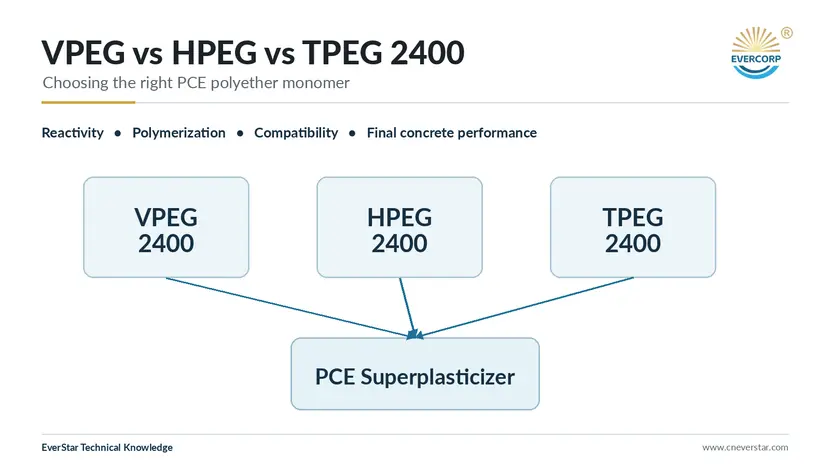
VPEG vs HPEG vs TPEG 2400: How to Choose the Right PCE Polyether Monomer
Polycarboxylate ether (PCE) superplasticizers are not defined by one single raw material. Their final performance depends on the complete polymer architecture, including the polyether macromonomer, carboxyl-containing monomers, molecular weight, grafting density, initiator system and polymerization conditions.
Among the most commonly discussed polyether macromonomers are VPEG, HPEG and TPEG, particularly commercial grades with an average molecular weight around 2400.
So which one should a PCE manufacturer choose?
The short answer is: There is no universally “best” PCE monomer. VPEG, HPEG and TPEG represent different macromonomer structures and commercial formulation routes, and the correct choice depends on polymerization efficiency, target PCE performance, cement compatibility, and production conditions.
This guide explains the practical differences between VPEG 2400, HPEG 2400, and TPEG 2400 and shows how concrete admixture manufacturers can evaluate them before changing raw-material suppliers.
What Are VPEG, HPEG and TPEG?
VPEG, HPEG, and TPEG are commercial names used for unsaturated polyether macromonomers used in the synthesis of polycarboxylate superplasticizers.
These macromonomers normally contain two important structural parts:
· a reactive unsaturated end group that participates in free-radical polymerization;
· a long hydrophilic polyoxyethylene chain that becomes a side chain of the finished PCE polymer.
During polymerization, the macromonomer is copolymerized with acrylic acid or other functional monomers.
The resulting PCE generally develops a comb-shaped molecular structure consisting of:
· an adsorption-active polymer backbone; and
· multiple hydrophilic polyether side chains.
When PCE adsorbs onto cement particles, these side chains create steric hindrance that helps prevent dispersed cement particles from reflocculating.
This mechanism is a major reason why PCE superplasticizers can provide strong dispersion at relatively low water-to-binder ratios.
Is the “2400” Molecular Weight the Main Difference?
No.
VPEG 2400, HPEG 2400 and TPEG 2400 may all have nominal molecular weights around 2400 g/mol, but molecular weight alone does not determine their behavior.
Two macromonomers with similar nominal molecular weights can still differ in:
· terminal unsaturated structure;
· reactivity during polymerization;
· molecular-weight distribution;
· hydroxyl value;
· unsaturation;
· residual moisture;
· double-bond retention;
· manufacturing process;
· batch consistency.
The finished PCE is also affected by variables such as:
· acid-to-ether ratio;
· initiator type;
· chain-transfer agent;
· feeding profile;
· reaction temperature;
· solids concentration;
· target polymer molecular weight;
· neutralization conditions.
For this reason, PCE manufacturers should avoid selecting a macromonomer only because the label says “2400.”
VPEG vs HPEG vs TPEG: Quick Comparison
|
Factor |
VPEG 2400 |
HPEG 2400 |
TPEG 2400 |
|
Main role |
PCE macromonomer |
PCE macromonomer |
PCE macromonomer |
|
Typical physical form |
Flakes |
Flakes |
Flakes |
|
Nominal MW |
Around 2400 |
Around 2400 |
Around 2400 |
|
Polymerization route |
Free-radical copolymerization |
Free-radical copolymerization |
Free-radical copolymerization |
|
Commercial positioning |
High-reactivity/newer PCE systems |
Widely established PCE systems |
Widely used in tailored PCE systems |
|
Key purchasing concern |
Reactivity and batch consistency |
Stable established formulation performance |
Compatibility with target formulation |
|
Final concrete performance |
Depends on complete PCE design |
Depends on complete PCE design |
Depends on complete PCE design |
Important: Commercial naming conventions are not completely standardized across all manufacturers. Buyers should evaluate the supplier's actual TDS, COA and polymerization performance rather than relying on the product name alone.

What Makes VPEG 2400 Different?
VPEG is generally associated with a highly reactive unsaturated polyether structure.
For PCE producers, increased macromonomer reactivity can provide more flexibility when designing polymerization processes, especially when manufacturers are interested in lower-temperature or high-conversion synthesis routes.
However, high reactivity does not automatically mean that the resulting PCE will always provide better water reduction or slump retention.
The performance still depends on whether the macromonomer is successfully integrated into the desired polymer architecture.
When Should You Evaluate VPEG?
VPEG 2400 may be worth evaluating when:
· developing a new-generation PCE formulation;
· optimizing polymerization temperature;
· improving raw-material conversion;
· designing PCE for difficult cement systems;
· trying to improve production efficiency;
· replacing an existing polyether monomer source.
Before changing from HPEG or TPEG to VPEG, manufacturers should conduct controlled synthesis trials rather than directly substituting one material kilogram-for-kilogram.
What Makes HPEG 2400 Different?
HPEG 2400 based macromonomers are widely used in commercial PCE production and have established formulation experience in many admixture factories.
For manufacturers already operating stable HPEG formulations, one of the biggest advantages is process familiarity.
Production teams may already understand:
· reaction temperature;
· feeding sequence;
· acid-to-ether ratio;
· initiator demand;
· chain-transfer requirements;
· final polymer viscosity;
· concrete performance.
Some commercial HPEG grades are designed specifically for workability-retention formulations, although this should be regarded as a grade-specific property rather than a universal characteristic of every HPEG material.
When Can HPEG Be a Good Choice?
HPEG may remain an appropriate option when:
· the existing PCE formulation is already stable;
· local cement compatibility has been validated;
· production consistency is more important than redesigning the polymer system;
· customers are satisfied with current concrete performance;
· switching monomers would create unnecessary formulation risk.
A newer monomer is not automatically more economical if changing it requires major reformulation.
What Makes TPEG 2400 Different?
TPEG is another widely used unsaturated polyether macromonomer for PCE synthesis.
Different TPEG grades are used for different PCE formulation objectives.
Depending on the manufacturer and molecular structure, commercial TPEG systems may be incorporated into formulations targeting:
· initial water reduction;
· workability control;
· temperature adaptability;
· specific cement compatibility;
· balanced early strength and flow retention.
As with HPEG and VPEG, the trade name alone cannot predict performance.
A supplier describing a TPEG grade as “high water reduction,” “low-temperature,” or “slump retention” should be able to support the claim through:
· product specifications;
· polymerization data;
· cement paste or mortar testing;
· concrete trial results.
Which Monomer Gives Better Water Reduction?
This question cannot be answered from the monomer name alone.
Water reduction is determined by how effectively the finished PCE disperses cement.
Important structural variables include:
Side-Chain Length
Polyether side chains create steric hindrance.
Changing their length can affect the ability of dispersed cement particles to remain separated.
Grafting Density
A polymer with too few side chains may not create sufficient steric stabilization.
Too many side chains can also change adsorption behavior.
Backbone Structure
The number and distribution of adsorption groups affect how strongly the PCE interacts with cement surfaces and early hydration products.
Polymer Molecular Weight
Molecular weight and molecular-weight distribution influence adsorption, conformation and rheological behavior.
For this reason:
VPEG versus HPEG versus TPEG should be treated as a polymer-design question, not simply a product-name comparison.

Which Monomer Provides Better Slump Retention?
Slump retention depends on more than the original polyether macromonomer.
It can be influenced by:
· PCE adsorption behavior;
· polymer architecture;
· cement C3A content;
· soluble sulfate concentration;
· alkali content;
· cement fineness;
· temperature;
· supplementary cementitious materials;
· aggregate clay content;
· admixture dosage.
A formulation performing well with one cement can lose workability rapidly with another cement.
Therefore, if long slump retention is the target, PCE manufacturers should test the finished polymer using actual cement from the target market rather than selecting HPEG, TPEG or VPEG only from a supplier's marketing description.
What About Sulfate Compatibility?
Sulfate concentration is an important factor in PCE performance.
Dissolved sulfate species can compete with PCE for adsorption sites on cement hydration phases and alter the interaction between the polymer and cement.
Research has shown that PCE molecular architecture influences sensitivity to sulfate.
This means that sulfate compatibility is primarily a property of the complete PCE structure and cement system.
Using VPEG, HPEG or TPEG alone cannot guarantee sulfate resistance.
For markets where cement sources change frequently, such as export markets and large ready-mix operations, compatibility testing should include several representative cement samples.
What About Clay-Tolerant PCE?
Clay contamination in natural sand and aggregates can significantly reduce the effectiveness of conventional PCE.
Certain clay minerals, particularly expandable layered clays, can strongly interact with polyether-containing superplasticizers.
This can consume part of the admixture before it performs its intended function on cement.
As a result, concrete may show:
· lower initial slump;
· rapid slump loss;
· increased PCE demand;
· inconsistent batch performance.
Clay tolerance normally requires deliberate polymer design.
Changing from HPEG to VPEG or TPEG by itself should not be considered a universal solution.
How Should a PCE Manufacturer Compare VPEG, HPEG and TPEG?

The most reliable method is a controlled side-by-side trial.
Step 1: Check Raw-Material Specifications
Compare:
· appearance;
· molecular weight;
· molecular-weight distribution where required;
· unsaturation;
· hydroxyl value;
· moisture;
· solids;
· double-bond retention or related reactivity indicators.
Step 2: Run Controlled Polymerization Trials
Keep major synthesis variables as consistent as possible.
Record:
· reaction temperature;
· feeding behavior;
· reaction stability;
· final solids;
· viscosity;
· pH;
· polymer appearance;
· conversion indicators.
Step 3: Test the Finished PCE
Do not stop at raw-material analysis.
Evaluate:
· cement paste flow;
· mortar flow;
· initial concrete slump;
· 30-, 60-, 90- and 120-minute workability;
· water-reduction performance;
· setting time;
· air content;
· bleeding or segregation;
· early strength;
· 28-day strength.
Step 4: Test More Than One Cement

A PCE formulation intended for export should ideally be evaluated with different cement chemistries.
This is especially important when selling admixtures to the Middle East, Latin America, Africa or Southeast Asia, where local cement and aggregate characteristics may differ significantly.
Step 5: Compare Total Production Cost
Do not compare only macromonomer price per ton.
The real calculation should include:
· macromonomer dosage;
· acrylic acid consumption;
· initiator demand;
· chain-transfer agent;
· reaction energy;
· production cycle;
· failed batches;
· formulation additives;
· customer complaints;
· final PCE dosage in concrete.
A slightly more expensive macromonomer may be economical if it improves conversion or formulation efficiency.
The opposite can also be true.
What Should Buyers Request From a Polyether Monomer Supplier?
Before approving a new VPEG, HPEG or TPEG supplier, request:
· current Technical Data Sheet;
· Safety Data Sheet;
· batch-specific Certificate of Analysis;
· representative production sample;
· packaging specification;
· storage recommendation;
· quality-management documentation;
· technical support for polymerization trials.
For industrial PCE production, batch-to-batch consistency is often more important than one unusually good laboratory sample.
FAQ
Is VPEG always better than HPEG?
No. VPEG may offer advantages in certain polymerization systems, but final PCE performance depends on the complete formulation and cement system.
Is TPEG better for slump retention?
Some TPEG formulations may be designed for specific flow or workability requirements, but TPEG as a general product category does not automatically guarantee longer slump retention.
Can I directly replace HPEG with VPEG at the same dosage?
It is not recommended without laboratory testing. Differences in reactive structure may require changes to the acid-to-ether ratio, initiator system, chain-transfer agent or feeding conditions.
Does 2400 molecular weight guarantee high water reduction?
No. Molecular weight is only one parameter. Polymer architecture, grafting density, adsorption behavior and cement chemistry are equally important.
Which monomer is best for high-sulfate cement?
There is no universal answer. Sulfate tolerance should be evaluated using the finished PCE and actual cement.
What is the best way to select a PCE monomer supplier?
Compare technical specifications, batch consistency and polymerization performance, then validate the resulting PCE using your own cement and formulation.
Source PCE Polyether Monomers From EverStar Group
EverStar Group supplies polyether macromonomers for manufacturers producing polycarboxylate ether superplasticizers.
Our product portfolio includes VPEG, HPEG and TPEG-based grades for different formulation and manufacturing requirements.
Customers can request:
· TDS;
· SDS;
· batch-specific COA;
· samples for laboratory polymerization;
· commercial quotations;
· export documentation.
If you are evaluating a new polyether monomer source, we recommend conducting a controlled polymerization and cement-compatibility trial before bulk purchasing.
Contact EverStar Group for current specifications and sample availability.
Email: info@cneverstar.com
References
1. Yamada, K., Takahashi, T., Hanehara, S. & Matsuhisa, M. Effects of the Chemical Structure on the Properties of Polycarboxylate-Type Superplasticizer. Cement and Concrete Research, 2000.
2. Winnefeld, F., Becker, S., Pakusch, J. & Götz, T. Effects of the Molecular Architecture of Comb-Shaped Superplasticizers on Their Performance in Cementitious Systems. Cement and Concrete Composites, 2007.
3. Plank, J., Sakai, E., Miao, C.W., Yu, C. & Hong, J.X. Chemical Admixtures—Chemistry, Applications and Their Impact on Concrete Microstructure and Durability. Cement and Concrete Research, 2015.
4. Influence of the Structures of Polycarboxylate Superplasticizer on Its Performance in Cement-Based Materials—A Review. Construction and Building Materials, 2020.
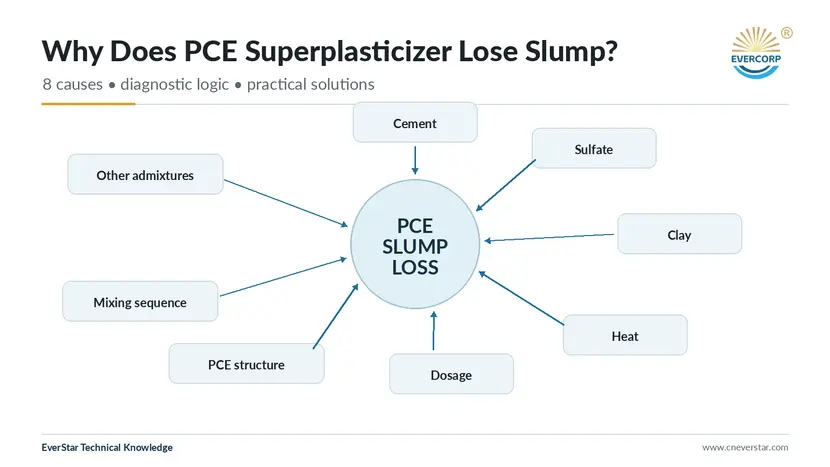
Why Does PCE Superplasticizer Lose Slump? 8 Causes and Practical Solutions
Polycarboxylate ether (PCE) superplasticizers are widely used because they can provide strong cement dispersion, high water reduction, and excellent workability at relatively low dosage.
Yet one problem repeatedly appears in ready-mix plants and PCE formulation laboratories:
The concrete looks excellent immediately after mixing, but its slump or slump flow decreases much faster than expected.
Why?
Rapid slump loss does not necessarily mean that the PCE itself is poor quality.
In many cases, the problem comes from interactions between the superplasticizer, cement, sulfate, clay, temperature, supplementary cementitious materials, water quality and mixing procedure.
This guide explains eight common causes of PCE slump loss and provides a practical troubleshooting process for concrete admixture manufacturers and ready-mix producers.

What Is Slump Loss?
Slump loss is the reduction in concrete workability with time after mixing.
Depending on the concrete type, workability may be monitored using:
· slump;
· slump flow;
· mortar flow;
· cement paste flow;
· rheological measurements.
A controlled reduction in workability is normal because cement hydration begins immediately after water is added.
The problem occurs when workability disappears faster than the transportation, pumping, placement or finishing process requires.
For example, concrete may have adequate workability at the batching plant but become difficult to pump or place after transportation.
1. Cement Chemistry Is Different
One of the first things to check when PCE suddenly loses slump is the cement.
PCE performance depends strongly on interactions with cement particles and early hydration products.
Important cement variables include:
· C3A content;
· sulfate content;
· alkali content;
· cement fineness;
· gypsum form;
· clinker composition;
· supplementary materials.
Two cements sold under the same strength class can behave differently with the same PCE.
This is why a formulation that performs well at one ready-mix plant may behave differently after the cement supplier changes.
Practical Solution
Whenever the cement source changes:
1. obtain a fresh cement sample;
2. repeat cement paste or mortar flow testing;
3. compare initial flow and flow retention;
4. check setting behavior;
5. repeat the full concrete trial before adjusting production dosage.
Do not immediately assume that the PCE batch is defective.
2. Soluble Sulfate Changes PCE Adsorption
Sulfate plays an important role in the early cement environment.
Dissolved sulfate species can interact with aluminate phases and compete with PCE molecules for adsorption sites.
Changes in sulfate availability can therefore change:
· how quickly PCE adsorbs;
· how much polymer remains in solution;
· initial dispersion;
· subsequent workability retention.
This explains why PCE may behave differently even when two cement samples have similar total SO3 values.
The form and availability of sulfate, not just total sulfate on a cement certificate, can matter.
Practical Solution
If slump loss appears after changing cement:
· compare the new cement with the previous cement;
· check sulfate and clinker information where available;
· conduct timed paste-flow tests;
· evaluate whether the current PCE structure is still suitable.
Changing PCE dosage alone may not solve a fundamental compatibility problem.
3. Clay Contamination Is Consuming the PCE

Clay is one of the most common reasons for unexpectedly high PCE demand.
Natural sand and manufactured sand may contain clay minerals.
Certain layered clay minerals can interact strongly with the polyether side chains of conventional PCE.
Instead of remaining available to disperse cement, part of the superplasticizer is consumed by the clay-containing aggregate system.
The result may include:
· low initial slump;
· rapid slump loss;
· unusually high PCE dosage;
· poor reproducibility;
· variable performance between aggregate deliveries.
This problem can become particularly serious when sand sources change frequently.
Practical Solution
Check:
· mud/clay content;
· methylene blue value where applicable;
· changes in manufactured-sand source;
· fine-particle content;
· aggregate washing conditions.
Possible solutions include:
· improving aggregate cleanliness;
· controlling clay-containing fines;
· using a PCE specifically designed for improved clay tolerance;
· reformulating the polymer architecture;
· blending compatible dispersing components.
Simply increasing standard PCE dosage can become expensive and may not provide stable performance.
4. Concrete Temperature Is Too High
Temperature has a major influence on hydration and workability loss.
As concrete temperature increases:
· hydration reactions accelerate;
· adsorption conditions change;
· evaporation increases;
· the available working time becomes shorter.
A PCE formulation that provides adequate retention at moderate temperature may not provide the same performance under hot-weather conditions.
This is particularly important in:
· Middle Eastern markets;
· tropical regions;
· summer ready-mix transportation;
· mass concrete projects;
· long-distance concrete delivery.
Practical Solution
Do not evaluate the formulation only at laboratory room temperature.
Conduct trials at temperatures representative of the actual market.
Possible adjustments may include:
· modifying the slump-retention component;
· optimizing the PCE molecular architecture;
· controlling concrete temperature;
· adjusting addition timing;
· evaluating compatible set-control components such as sodium gluconate where appropriate.
Any retarder or set-control adjustment should be verified through setting-time and strength testing.
5. PCE Dosage Is Below the Effective Range
Concrete producers sometimes reduce PCE dosage to control cost.
However, if the dosage moves below the level required to adequately disperse the actual cement and fines, workability can deteriorate quickly.
The effective dosage depends on:
· cement surface area;
· supplementary cementitious materials;
· aggregate fines;
· clay;
· water-to-binder ratio;
· PCE solids;
· polymer structure.
A dosage that worked with the previous raw-material system may not be adequate after the cement or aggregate changes.
Practical Solution
Create a dosage-response curve.
Test several dosage levels while keeping all other variables constant.
Measure:
· initial flow;
· 30-minute flow;
· 60-minute flow;
· 90-minute flow;
· setting behavior;
· segregation or bleeding.
This helps identify whether the system is under-dosed or whether the problem is a true compatibility issue.
6. The PCE Structure Does Not Match the Application
Not every PCE is designed for the same purpose.
Commercial PCE products may be optimized for:
· high initial water reduction;
· extended slump retention;
· precast early strength;
· self-compacting concrete;
· low-viscosity concrete;
· clay tolerance;
· specialized cement systems.
A high-water-reducing PCE may create excellent initial flow but still lose workability faster than a deliberately designed slump-retention grade.
Conversely, a strong retention formulation may not provide the same initial water reduction.
Why Molecular Structure Matters
PCE performance can be influenced by:
· side-chain length;
· side-chain density;
· backbone length;
· carboxyl-group density;
· molecular weight;
· molecular-weight distribution;
· functional monomers.
This is why PCE should be selected according to the target concrete performance rather than only comparing solid content or price.
For a deeper explanation of how PCE molecular architecture creates high water reduction, see our guide to how polycarboxylate superplasticizer works.
7. Mixing Sequence Is Affecting Performance
Addition timing can change how a superplasticizer interacts with cement.
For some systems, adding all admixture immediately with the first mixing water produces different behavior from delayed addition.
This happens because cement hydration and sulfate dissolution begin as soon as cement contacts water.
The chemical environment seen by the PCE therefore changes with time.
Practical Solution
Compare several controlled addition sequences, for example:
Method A: PCE added with initial mixing water.
Method B: Part of the water is mixed first, followed by PCE.
Method C: Split addition where permitted by the production system.
Evaluate both initial workability and retention.
The best sequence depends on the cement and admixture system.
8. Other Admixtures Are Interacting With PCE
Modern concrete rarely contains only one admixture.
The system may also contain:
· sodium gluconate;
· air-entraining agents;
· defoamers;
· viscosity-modifying agents;
· accelerators;
· shrinkage-reducing admixtures;
· corrosion inhibitors.
These materials can change:
· adsorption;
· hydration;
· air content;
· viscosity;
· setting time;
· slump retention.
A formulation should therefore be tested as a complete admixture package.
Testing PCE by itself does not always predict the final field result.
A Practical PCE Slump-Loss Troubleshooting Workflow
When a customer reports rapid slump loss, avoid changing several variables at the same time.
Use a controlled diagnostic process.
Step 1: Confirm What Changed
Ask whether there was a recent change in:
· cement supplier;
· cement batch;
· sand source;
· manufactured sand;
· fly ash;
· slag;
· mixing water;
· ambient temperature;
· admixture batch;
· dosage;
· mixing sequence.
Very often, the problem begins immediately after one raw-material change.
Step 2: Reproduce the Problem
Use the actual customer materials whenever possible.
Do not rely only on your standard laboratory cement.
Step 3: Run Timed Flow Tests

Record workability at consistent intervals.
For example:
|
Time |
Test |
|
Initial |
Paste/mortar/concrete flow |
|
30 min |
Flow retention |
|
60 min |
Flow retention |
|
90 min |
Flow retention |
|
120 min |
Flow retention if required |
The shape of the flow-loss curve provides more information than one initial measurement.
Step 4: Isolate Cement and Aggregate Effects
Test:
· cement + PCE;
· cement + PCE + clean reference sand;
· cement + PCE + customer’s sand.
If the problem appears only after adding the customer’s aggregate, clay or fines should be investigated.
Step 5: Compare PCE Dosage
Establish whether increased dosage improves the result.
If substantially more PCE is required to obtain the same flow, raw-material adsorption or contamination may be involved.
Step 6: Compare PCE Formulations
If the basic PCE cannot provide the required retention, compare:
· water-reducing PCE;
· slump-retention PCE;
· blended PCE systems;
· clay-tolerant formulations where required.
Step 7: Check Setting Time and Strength
Never solve slump loss by considering flow alone.
An adjustment that improves retention can also affect:
· initial setting;
· final setting;
· early strength;
· air content;
· bleeding;
· segregation.
The complete concrete performance must remain acceptable.
Can Sodium Gluconate Help With Slump Retention?
Sodium gluconate is commonly evaluated as a set-control component in concrete admixture formulations.
Its primary role is different from PCE.
PCE primarily provides:
· cement dispersion;
· water reduction;
· flowability.
Sodium gluconate primarily contributes to:
· controlled early hydration;
· setting-time adjustment;
· extended workability in suitable systems.
When the two are properly formulated together, they can support concrete requiring high initial fluidity and longer working time.
However, dosage must be verified carefully.
Excessive retardation can create unacceptable setting delays, particularly when temperature, cement chemistry or other retarders are also involved.
How Can PCE Manufacturers Improve Cement Compatibility?
Instead of designing one PCE and expecting it to work everywhere, manufacturers can build a compatibility-testing system.
A useful test library may include:
· high-C3A cement;
· different sulfate levels;
· limestone-containing cement;
· slag cement;
· fly-ash blends;
· manufactured sand;
· clay-contaminated sand;
· high-temperature testing.
This allows the formulation team to understand where each PCE grade performs best.
For exporters, this is especially important because raw materials used by customers in Mexico, Brazil, the Middle East, Southeast Asia and other regions may differ significantly from the cement used in the supplier’s domestic laboratory.

FAQ
Why does PCE have good initial flow but poor retention?
The formulation may be optimized for initial dispersion rather than long-term workability, or the cement, sulfate, temperature or aggregate system may be causing rapid loss.
Does increasing PCE dosage always solve slump loss?
No. Increasing dosage may help an under-dosed system, but it cannot reliably solve every cement-compatibility or clay problem.
Why does changing cement affect the same PCE?
Different cements have different mineralogy, sulfate availability, fineness and surface characteristics, which influence PCE adsorption and hydration.
Does clay reduce PCE performance?
Yes. Certain clay minerals can interact strongly with PCE and substantially increase admixture demand.
Can sodium gluconate be used with PCE?
Yes, it is commonly evaluated in admixture formulations requiring setting control or extended workability. The complete formulation should be tested with actual cement.
Should PCE be tested with local cement?
Yes. Testing with representative customer cement and aggregates is one of the most important steps in formulation development.
Work With EverStar Group on PCE and Concrete Admixture Raw Materials
EverStar Group supplies PCE superplasticizers, polyether macromonomers and concrete set-control raw materials for concrete admixture manufacturers and construction-material producers.
For technical evaluation, customers can request:
· TDS;
· SDS;
· batch-specific COA;
· product samples;
· commercial quotations;
· export documentation.
When evaluating PCE performance, we recommend using your actual cement, aggregates and complete admixture package before commercial-scale adoption.
Contact EverStar Group for technical documentation and sample availability.
Email: info@cneverstar.com
References
1. Yamada, K., Ogawa, S. & Hanehara, S. Controlling of the Adsorption and Dispersing Force of Polycarboxylate-Type Superplasticizer by Sulfate Ion Concentration in Aqueous Phase. Cement and Concrete Research, 2001.
2. Lei, L. & Plank, J. A Concept for a Polycarboxylate Superplasticizer Possessing Enhanced Clay Tolerance. Cement and Concrete Research, 2012.
3. Plank, J., Sakai, E., Miao, C.W., Yu, C. & Hong, J.X. Chemical Admixtures—Chemistry, Applications, and Their Impact on Concrete Microstructure and Durability. Cement and Concrete Research, 2015.
4. Influence of the Structures of Polycarboxylate Superplasticizer on Its Performance in Cement-Based Materials—A Review. Construction and Building Materials, 2020.
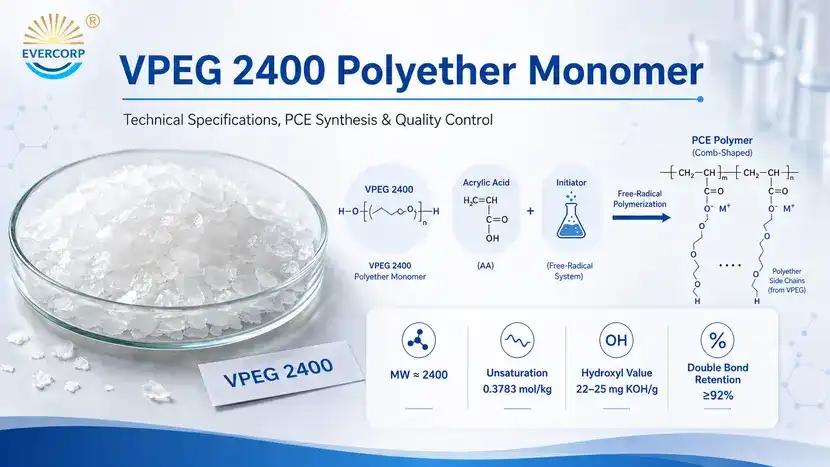
VPEG 2400 Polyether Monomer: Technical Specifications, PCE Synthesis & Quality Control
VPEG 2400 is an unsaturated polyether macromonomer used primarily as a raw material for the synthesis of polycarboxylate ether (PCE) superplasticizers.
Unlike a finished concrete admixture, VPEG 2400 is not normally added directly to concrete. Instead, it participates in polymerization with acrylic acid and other functional monomers to form the polyether side chains of a comb-shaped PCE molecule.
For PCE manufacturers, the quality of the macromonomer can influence polymerization consistency, molecular architecture and ultimately the performance stability of the finished superplasticizer.
This guide explains the role of VPEG 2400 in PCE synthesis, the meaning of its key technical specifications, the factors that affect final PCE performance and the quality-control procedures buyers should consider before commercial production.
What Is VPEG 2400 Polyether Monomer?
VPEG 2400 is a commercial polyether macromonomer with an average molecular weight of approximately 2400 g/mol.
It is generally supplied as white to light-yellow flakes and contains a reactive unsaturated functionality that allows the macromonomer to participate in free-radical copolymerization.
During PCE synthesis, VPEG contributes long hydrophilic polyether side chains to the resulting polymer.
These side chains are important because modern PCE superplasticizers rely strongly on steric effects to maintain the separation of cement particles in an aqueous system.
Commercial naming conventions for PCE macromonomers may vary between manufacturers and markets. Buyers should therefore evaluate a material according to its technical specification, TDS, SDS, COA and actual polymerization behavior rather than relying only on commercial names such as VPEG, HPEG or TPEG.
What Role Does VPEG 2400 Play in PCE Synthesis?
A typical PCE molecule has a comb-shaped architecture consisting of an anionic polymer backbone and multiple polyether side chains.
During synthesis, VPEG 2400 acts as one of the macromonomer building blocks used to introduce these polyether side chains.
Acrylic acid or other carboxyl-containing monomers are commonly incorporated into the backbone so that the finished PCE contains adsorption groups capable of interacting with cement surfaces.
The general process can be summarized as:

VPEG macromonomer + carboxyl-containing monomers + initiator system → polycarboxylate ether polymer
The exact polymerization conditions vary according to the target PCE structure.
Important variables can include:
- acid-to-ether ratio;
- initiator system;
- chain-transfer agent;
- reaction temperature;
- feeding profile;
- solids concentration;
- target polymer molecular weight;
- required water-reduction or workability-retention behavior.
Published research confirms that the molecular architecture of PCE strongly affects cement dispersion and rheology.
For example, changes in polyether side-chain length, side-chain density and polymer molecular weight can significantly change the performance of the finished superplasticizer.[1][2]
More recent research has also demonstrated the use of high-reactivity VPEG macromonomers for PCE synthesis under relatively low-temperature reaction conditions.[3]
This does not mean that every VPEG grade automatically produces the same result.
The final performance depends on the complete polymerization system and should always be verified experimentally.
How Does the Resulting PCE Disperse Cement?
Once the finished PCE is added to a cementitious system, adsorption groups on the polymer backbone interact with cement particles and early hydration products.
At the same time, the polyether side chains extend into the surrounding aqueous phase.
These side chains create steric hindrance between neighboring particles, making it more difficult for dispersed cement particles to reflocculate.
As a result, water that would otherwise remain trapped inside cement agglomerates becomes more available to the system.
This mechanism is one of the reasons PCE superplasticizers can provide strong dispersion at relatively low water-to-binder ratios.
However, concrete performance cannot be predicted from VPEG molecular weight alone.
The final result is influenced by the entire PCE molecular architecture as well as cement chemistry, admixture dosage, temperature, supplementary cementitious materials and aggregate quality.[1][2]
VPEG 2400 Technical Specifications

The following values correspond to the current EverStar Group VPEG 2400 product specification.
| Parameter | Current Specification |
|---|---|
| Appearance | White or light-yellow flakes |
| Average Molecular Weight | Approx. 2400 g/mol |
| Unsaturation | 0.3783 mol/kg |
| Hydroxyl Value | 22–25 mg KOH/g |
| Double Bond Retention | ≥92% |
| CAS No. | 31497-33-3 |
Specifications may be updated as product grades and manufacturing processes are optimized. Buyers should always confirm the latest TDS and batch-specific COA before commercial use.
What Do These Specifications Mean for PCE Manufacturers?
1. Average Molecular Weight
The nominal molecular weight indicates the approximate size of the polyether macromonomer and therefore relates to the polyether side-chain architecture that can be introduced into the PCE.
A value around 2400 g/mol is widely used as a commercial macromonomer grade, but it should not be interpreted as a universal optimum for every PCE formulation.
Research on PCE molecular architecture shows that side-chain length interacts with other variables including grafting density, backbone composition and polymer molecular weight.[1][2]
For this reason, the best formulation should be established through controlled synthesis and cement testing.
2. Unsaturation
Unsaturation is related to the reactive functionality available for copolymerization.
For PCE manufacturers, consistency in this parameter is important because variation in reactive functionality can influence polymerization behavior and the architecture of the resulting polymer.
A supplier should therefore demonstrate stable batch-to-batch values rather than relying on one exceptionally good sample.
3. Double Bond Retention
Double bond retention indicates how well the reactive unsaturated functionality of the macromonomer has been preserved during manufacturing and storage.
Higher and more consistent retention generally provides a more predictable starting material for polymerization.
However, double bond retention alone does not determine polymer conversion.
Conversion also depends on initiator chemistry, monomer ratios, feeding conditions, reaction temperature and other process variables.
4. Hydroxyl Value
Hydroxyl value is another useful quality-control parameter for polyether materials.
For a PCE producer, the most important consideration is usually consistency within the approved specification because significant changes may indicate differences in the macromonomer structure or production process.
5. Appearance
VPEG 2400 is supplied as flakes.
Incoming materials should be checked for abnormal discoloration, contamination, excessive caking or other changes compared with the approved reference sample.
Visual inspection cannot replace analytical testing, but it is an efficient first step in incoming quality control.
Why VPEG Reactivity Matters During Polymerization
A macromonomer must participate effectively in the copolymerization reaction if the intended PCE architecture is to be obtained.
High-reactivity VPEG macromonomers have attracted attention because they can provide greater flexibility in free-radical PCE synthesis.
A 2024 study published in Langmuir used a high-reactivity VPEG macromonomer to prepare PCE under low-temperature conditions and found that changing the acid-to-ether ratio significantly influenced adsorption, fluidity and rheological behavior.[3]
This demonstrates an important principle:
The macromonomer provides the molecular building block, but the synthesis recipe determines how that building block is incorporated into the finished polymer.
For this reason, buyers should not judge a VPEG grade only by its raw-material specification.
A proper evaluation should include an actual PCE synthesis trial.
Factors That Influence Final PCE Performance
1. Acid-to-Ether Ratio
The ratio between carboxyl-containing monomers and the polyether macromonomer influences charge density and adsorption behavior.
Changing this ratio can alter cement dispersion, rheology and other performance characteristics.
2. PCE Molecular Architecture
Side-chain length, grafting density, backbone length and molecular-weight distribution interact with each other.
Scientific studies have repeatedly shown that PCE performance is controlled by the complete polymer structure rather than a single parameter.[1][2][4]
3. Cement Sulphate Chemistry
Cement chemistry is one of the most important reasons the same PCE can behave differently with different cement sources.
Sulphate ions in the aqueous phase can compete with PCE molecules for adsorption sites on cement surfaces.
Research has shown that increasing sulphate-ion concentration can reduce PCE adsorption and dispersing efficiency.[5]
Therefore, claims such as “universal sulphate resistance” should not replace compatibility testing.
If a PCE manufacturer supplies several regional markets, the formulation should ideally be tested using representative local cements.
4. Clay Contamination
Clay minerals in aggregates can also interfere with conventional PCE systems.
Montmorillonite is particularly important because polyether side chains can interact strongly with layered clay structures, reducing the amount of effective PCE available for cement dispersion.
Research into clay-tolerant PCEs shows that improved resistance is achieved through specific polymer-architecture modifications.[6]
This means ordinary VPEG 2400 should not automatically be described as a clay-resistant monomer.
Clay tolerance is primarily a property of the final PCE molecular design.

5. Temperature and Raw-Material Variability
Reaction temperature affects PCE synthesis, while concrete temperature affects adsorption, hydration and workability retention.
At the same time, differences in cement, supplementary cementitious materials, sand and aggregate can change the required PCE formulation.
For commercial production, laboratory testing should therefore be designed to represent real raw materials rather than idealized conditions only.
Quality Control Methods for VPEG 2400

Quality control should distinguish between routine incoming inspection and advanced structural characterization.
Routine Incoming Inspection
For each commercial batch, buyers should consider checking the parameters included in their approved raw-material specification.
This may include:
- appearance;
- unsaturation;
- hydroxyl value;
- reactive-functionality indicators;
- other parameters specified in the agreed COA.
The batch number on the COA should correspond to the actual shipment.
Molecular-Weight Characterization
Gel permeation chromatography (GPC), also called size-exclusion chromatography, can be used when molecular-weight distribution needs to be investigated.
This type of analysis is especially useful during supplier qualification, formulation troubleshooting or comparison of different macromonomer grades.
Structural Characterization
NMR spectroscopy can be used in research and advanced quality-control environments to investigate molecular structure and unsaturated functionality.
It is a valuable characterization method but does not necessarily need to be performed on every commercial shipment.
Moisture Analysis
Where moisture is part of the purchasing specification, suitable analytical methods such as Karl Fischer titration can provide accurate moisture determination.
The test method and acceptance limit should be agreed between buyer and supplier.
How to Evaluate VPEG 2400 Before Bulk Purchasing
Changing the macromonomer source can influence the complete PCE process.
A structured trial therefore provides more useful information than comparing COA values alone.
Step 1: Verify the Raw Material
Compare the sample with the approved specification and existing raw material.
Check the relevant physical and chemical parameters and record any significant difference.
Step 2: Conduct a Controlled PCE Synthesis Trial
Use the VPEG sample in a laboratory or pilot-scale synthesis.
Keep major process variables as consistent as possible so that the new material can be compared with the current reference.
Record:
- reaction temperature;
- feeding behavior;
- reaction stability;
- final solids;
- viscosity;
- pH;
- appearance;
- any unusual foaming or processing behavior.
Step 3: Test the Finished PCE With Actual Cement
Test the resulting PCE using cement representative of the target market.
Where customers use several cement suppliers, more than one cement should be included.
Step 4: Evaluate Required Performance
Depending on the intended PCE grade, testing may include:
- initial paste flow;
- flow retention;
- concrete slump or slump flow;
- water reduction;
- setting time;
- air content;
- rheological behavior;
- early and later strength;
- compatibility with other admixture components.
Step 5: Confirm Batch Consistency
After the initial sample passes evaluation, compare more than one commercial production batch before making a major supplier change.
For industrial PCE manufacturing, predictable consistency is often more valuable than unusually high performance from a single sample.
Storage and Handling
VPEG 2400 should be stored according to the current supplier SDS and technical recommendations.
General good practice includes:
- keeping packages in a cool and dry warehouse;
- protecting the material from moisture and direct sunlight;
- avoiding unnecessary exposure to high temperatures;
- keeping unopened packaging sealed;
- resealing partially used packaging promptly;
- inspecting material that has been stored for an extended period before use.
Warehouse personnel should follow the current SDS for personal protective equipment, spill response and handling requirements.
FAQ
Is VPEG 2400 a finished concrete superplasticizer?
No.
VPEG 2400 is a raw-material macromonomer used to synthesize polycarboxylate ether superplasticizers.
The finished PCE, rather than VPEG 2400 itself, is normally dosed into concrete.
Why is VPEG 2400 used in PCE synthesis?
It provides polyether side-chain functionality that can be incorporated into comb-shaped PCE polymers.
These side chains play an important role in the steric stabilization mechanism of the resulting superplasticizer.
Does molecular weight 2400 guarantee better water reduction?
No.
Macromonomer molecular weight is only one design parameter.
Final PCE performance also depends on side-chain density, backbone chemistry, acid-to-ether ratio, polymer molecular weight, cement chemistry and dosage.
What is the most important quality parameter when purchasing VPEG 2400?
There is no single parameter that determines overall quality.
PCE manufacturers should evaluate the complete specification together with batch consistency and actual polymerization performance.
Unsaturation, double bond retention, molecular weight and hydroxyl value are all useful parameters depending on the approved purchasing specification.
Can VPEG 2400 solve sulphate compatibility problems by itself?
Not automatically.
Sulphate ions can influence PCE adsorption and dispersion, but compatibility depends on the complete PCE molecular structure and the cement system.
Testing with actual local cement is the correct way to evaluate performance.
Can VPEG 2400 be used to produce clay-tolerant PCE?
VPEG may be part of a PCE formulation, but clay tolerance generally requires specific polymer design.
Published research shows that clay resistance is strongly related to how the finished PCE interacts with clay minerals rather than to the use of one standard macromonomer alone.
Source VPEG 2400 From EverStar Group
EverStar Group supplies VPEG 2400 polyether monomer for manufacturers producing polycarboxylate ether superplasticizers.
Our current VPEG 2400 grade is supplied as white to light-yellow flakes with an average molecular weight of approximately 2400 g/mol, controlled unsaturation, hydroxyl value and double-bond retention.
For technical evaluation, customers can request:
- current TDS;
- SDS;
- batch-specific COA;
- product sample for laboratory testing;
- commercial quotation and export documentation.
Before changing a raw-material source, we recommend evaluating VPEG 2400 using your own PCE synthesis process and local cement system.
Contact EverStar Group for the latest specification, sample availability and commercial terms.
Email: info@cneverstar.com
References
- Yamada, K., Takahashi, T., Hanehara, S., & Matsuhisa, M. (2000). Effects of the chemical structure on the properties of polycarboxylate-type superplasticizer. Cement and Concrete Research, 30(2), 197–207. DOI: 10.1016/S0008-8846(99)00230-6.
- Winnefeld, F., Becker, S., Pakusch, J., & Götz, T. (2007). Effects of the molecular architecture of comb-shaped superplasticizers on their performance in cementitious systems. Cement and Concrete Composites, 29(4), 251–262. DOI: 10.1016/j.cemconcomp.2006.12.006.
- Chang, Q., Hu, M., et al. (2024). Preparation of a Polycarboxylate Superplasticizer with Different Monomer Regulations and Its Effect on Fluidity, Rheology, and Strength of Cement. Langmuir, 40(11), 5673–5687. DOI: 10.1021/acs.langmuir.3c03021.
- Plank, J., Sakai, E., Miao, C. W., Yu, C., & Hong, J. X. (2015). Chemical admixtures—Chemistry, applications and their impact on concrete microstructure and durability. Cement and Concrete Research, 78, 81–99. DOI: 10.1016/j.cemconres.2015.05.016.
- Yamada, K., Ogawa, S., & Hanehara, S. (2001). Controlling of the adsorption and dispersing force of polycarboxylate-type superplasticizer by sulfate ion concentration in aqueous phase. Cement and Concrete Research, 31(3), 375–383. DOI: 10.1016/S0008-8846(00)00503-2.
- Lei, L., & Plank, J. (2012). A concept for a polycarboxylate superplasticizer possessing enhanced clay tolerance. Cement and Concrete Research, 42(10), 1299–1306. DOI: 10.1016/j.cemconres.2012.07.001.
VPEG 2400 PCE Monomer for Concrete: Applications, Benefits & Selection Guide
Polycarboxylate ether (PCE) superplasticizers have become one of the most important technologies in modern concrete because their molecular structure can be tailored to provide high water reduction, improved flowability and controlled workability retention.
At the center of PCE synthesis is the polyether macromonomer.
VPEG 2400 PCE Monomer for Concrete is an unsaturated polyether macromonomer with an average molecular weight of approximately 2400 g/mol. It is designed as a raw material for synthesizing polycarboxylate superplasticizers rather than as an admixture that is added directly to concrete.
For PCE manufacturers, selecting a suitable macromonomer is important because monomer reactivity, molecular architecture, purity and batch consistency can influence polymerization behavior and, ultimately, the performance of the resulting superplasticizer.
This guide explains how VPEG 2400 works, where it is used, which specifications matter most, how it compares with other PCE macromonomers and what buyers should evaluate before placing a commercial order.
What Is VPEG 2400 PCE Monomer?
VPEG 2400 is a polyether macromonomer containing an unsaturated reactive group and a polyethylene oxide chain. During PCE production, the reactive group participates in free-radical copolymerization with acrylic acid and/or other functional monomers.
The resulting PCE generally has a comb-like molecular architecture consisting of:
- a polymer backbone containing adsorption or anchoring groups;
- polyether side chains extending into the aqueous phase;
- functional groups whose type and distribution can be adjusted during polymer design.
This molecular architecture is one of the main reasons PCE technology can provide much stronger dispersing performance than earlier generations of conventional concrete plasticizers.
Research on PCE systems has shown that the polymer adsorbs onto cement particle and hydration-product surfaces, while the polyether side chains generate steric repulsion that helps separate previously flocculated cement particles. This releases water trapped inside cement agglomerates and improves the flowability of the cementitious system.[1][2]
VPEG 2400 therefore should be viewed as a building block for PCE molecular design, rather than as a stand-alone concrete admixture.

Typical VPEG 2400 Product Parameters
For EverStar Group's current VPEG 2400 grade, representative specifications include:
| Parameter | Specification |
|---|---|
| Appearance | White or light yellow flakes |
| Average Molecular Weight | Approx. 2400 g/mol |
| Unsaturation | Approx. 0.3783 mol/kg |
| Hydroxyl Value | 22–25 mg KOH/g |
| Double Bond Retention | ≥92% |
| CAS Number | 31497-33-3 |
Product specifications may be adjusted as manufacturing processes and grades are optimized. Buyers should always confirm the latest TDS and batch-specific COA before commercial purchasing or formulation work.
Commercial naming conventions for PCE macromonomers can also vary among manufacturers and markets. For this reason, buyers should verify the chemical identity, technical specification and actual polymerization performance of a product instead of relying only on terms such as VPEG, HPEG or TPEG.
How Does VPEG 2400 Work in PCE Synthesis?

The concrete performance associated with VPEG does not come directly from the VPEG monomer itself. It develops after VPEG has been copolymerized into a properly designed polycarboxylate superplasticizer.
1. Formation of Polyether Side Chains
During polymerization, VPEG introduces long polyether side chains into the PCE molecule.
Once the finished PCE is added to cement paste, its adsorption groups can interact with cement surfaces while the hydrophilic polyether chains extend into the surrounding aqueous phase.
These side chains create steric hindrance between cement particles, helping prevent reflocculation.
The result can be improved dispersion and the possibility of producing concrete at lower water-to-binder ratios while maintaining the required workability.
2. Molecular Architecture Can Be Adjusted
PCE performance cannot be determined by molecular weight alone.
Side-chain length, grafting density, backbone composition, charge density, acid-to-ether ratio, molecular-weight distribution and functional comonomers can all influence adsorption, dispersion, rheology, setting behavior and slump retention.
Research by Winnefeld et al. demonstrated that changing the molecular architecture of comb-shaped PCE superplasticizers—including polyether side-chain length and density—significantly affects their behavior in cementitious systems.[3]
This is why two PCE products manufactured from macromonomers with similar nominal molecular weights may still perform differently in concrete.
3. High-Reactivity VPEG and Low-Temperature PCE Synthesis
One interesting development in modern PCE technology is the use of high-reactivity VPEG-type macromonomers.
A 2024 study published in Langmuir used a high-reactivity VPEG macromonomer to prepare different PCE structures under low-temperature reaction conditions. The researchers also demonstrated that changing the acid-to-ether ratio altered adsorption, cement fluidity and rheological behavior.[4]
This supports an important practical point for PCE manufacturers:
High-reactivity VPEG-type macromonomers can provide greater flexibility in designing efficient polymerization processes, including low-temperature synthesis under suitable initiator and formulation conditions.
However, reaction temperature, reaction time and conversion efficiency depend on the entire synthesis system. They should therefore be determined through laboratory and production trials rather than assumed from the monomer type alone.
Main Applications of VPEG 2400
The direct application of VPEG 2400 is the synthesis of polycarboxylate ether superplasticizers.
The resulting PCE formulations can then be designed for different concrete Applications.
1. High-Water-Reducing PCE Superplasticizers
VPEG-based PCE can be formulated for strong cement dispersion and efficient water reduction.
Such admixtures are commonly relevant to:
- high-strength concrete;
- high-performance concrete;
- pumping concrete;
- precast concrete;
- ready-mix concrete;
- self-compacting concrete;
- infrastructure concrete.
The actual water-reducing performance depends on the final PCE structure, dosage and concrete raw materials.
2. Slump-Retention PCE Systems
Ready-mix concrete may need to remain workable during batching, transport, pumping and placement.
PCE manufacturers can modify molecular architecture and formulation to control adsorption behavior over time and achieve the required balance between initial dispersion and workability retention.
VPEG 2400 can serve as one of the macromonomer building blocks in these formulations.
It is important, however, not to assume that a 2400 molecular weight automatically guarantees a specific slump-retention time. Cement composition, temperature, supplementary cementitious materials, aggregate quality and other admixtures can all affect final performance.
3. PCE for Variable Cement Chemistry
One of the most difficult challenges for admixture manufacturers is maintaining consistent performance when cement chemistry changes.
Sulphate is particularly important.
Research has shown that excessive sulphate ions in cementitious systems can competitively adsorb on cement surfaces and reduce the adsorption and dispersing efficiency of PCE superplasticizers.[5]
Alkali sulphates such as sodium sulphate and potassium sulphate can have particularly significant effects on PCE behavior.
For this reason, PCE manufacturers targeting markets with variable cement chemistry should evaluate VPEG-based formulations using actual local cement rather than depending only on a standard laboratory cement.
The correct question is therefore not:
“Is VPEG automatically sulphate-resistant?”
but rather:
“Can this VPEG grade help us design a PCE formulation that maintains satisfactory performance with the cement chemistry used in our target market?”
That question can only be answered through controlled compatibility testing.
4. High-Performance and Low Water-to-Binder Concrete
PCE technology is especially important in concrete systems where high flowability is required at a relatively low water-to-binder ratio.
Modern PCE superplasticizers have contributed to the development of high-performance concrete, self-compacting concrete and ultra-high-performance concrete by allowing cementitious materials to remain workable with reduced mixing water.[1][2]
VPEG 2400 can be used as a raw material in designing PCE systems for these applications.
Key Advantages of VPEG 2400 for PCE Manufacturers
1. Flexible Molecular Design
The biggest advantage of a modern polyether macromonomer is not a single fixed concrete performance number.
It is the ability to serve as part of a controllable molecular design platform.
By adjusting VPEG dosage, acid-to-ether ratio, chain-transfer system, initiator system and other comonomers, PCE manufacturers can develop formulations targeting different combinations of:
- initial dispersion;
- water reduction;
- workability retention;
- viscosity and flow behavior;
- cement compatibility;
- setting characteristics.
This flexibility is more valuable than claiming that one VPEG grade is universally better in every cement system.
2. High Reactivity for PCE Polymerization
Maintaining the reactive unsaturated functionality of a macromonomer is important for predictable copolymerization.
Parameters such as unsaturation and double-bond retention therefore deserve close attention during purchasing and incoming quality control.
Consistent reactive functionality helps manufacturers maintain more stable polymer architecture and batch-to-batch synthesis behavior.
3. Potential for Mild or Low-Temperature Synthesis
Research using high-reactivity VPEG has demonstrated successful low-temperature synthesis of PCE under specifically designed reaction conditions.[4]
For commercial manufacturers, this creates opportunities to investigate lower-temperature or shorter synthesis routes depending on:
- initiator chemistry;
- reactor configuration;
- monomer concentration;
- acid-to-ether ratio;
- chain-transfer agent;
- target PCE molecular weight.
Actual energy savings should be calculated from the manufacturer's own plant data instead of using a universal percentage.
4. Suitable for Different PCE Performance Targets
VPEG 2400 can be incorporated into PCE formulations designed for different market requirements.
However, the relationship between monomer structure and concrete performance is not linear. A longer side chain or higher molecular weight does not automatically mean better performance.
Scientific studies consistently show that the complete molecular architecture of PCE controls its interaction with cement.[2][3]
VPEG vs HPEG vs TPEG: What Should Buyers Know?

There is no simple rule stating that one macromonomer is superior to all others.
Different polyether macromonomers have different unsaturated structures and polymerization characteristics, while the final PCE performance is determined by both monomer chemistry and formulation design.
A practical comparison is:
| Factor | VPEG-Type Macromonomer | HPEG/TPEG-Type Macromonomers |
|---|---|---|
| Main Use | PCE synthesis | PCE synthesis |
| Polyether Side Chain | Yes | Yes |
| Unsaturated Reactive Group | Structure depends on grade | Structure depends on grade |
| Polymerization Behavior | High-reactivity grades are available | Mature commercial synthesis routes |
| Concrete Performance | Depends on final PCE architecture | Depends on final PCE architecture |
| Best Selection Method | Synthesis + cement compatibility testing | Synthesis + cement compatibility testing |
The international PCE market now includes several generations and structures of polyether macromonomers. Reviews of modern PCE technology describe HPEG and IPEG as major commercial systems while newer vinyl-ether PCE structures continue to broaden the available molecular design options.[2]
Therefore, procurement teams should avoid choosing a monomer only because it is described as a “new generation.”
What matters is whether the material produces the required PCE performance under your own synthesis and concrete conditions.
Key Specifications to Check Before Buying VPEG 2400
When evaluating VPEG 2400 suppliers, do not compare quotations by price alone.
Several technical parameters are more important for long-term production stability.
1. Molecular Weight and Distribution
A nominal molecular weight around 2400 indicates the approximate length of the polyether chain.
However, molecular-weight distribution is also important because broad variations may influence polymerization consistency.
Where necessary, manufacturers may use analytical methods such as GPC to evaluate molecular-weight distribution.
2. Unsaturation and Double-Bond Retention
The unsaturated group is responsible for incorporating the macromonomer into the polymer backbone during copolymerization.
Consistent unsaturation and good retention of reactive functionality therefore provide useful information about manufacturing control and storage stability.
Buyers should compare these parameters across multiple batches rather than relying on one sample.
3. Hydroxyl Value
Hydroxyl value is another useful quality-control parameter associated with the polyether structure.
For repeat purchases, consistency is generally more important than simply targeting an isolated number.
4. Moisture and Active Content
Moisture should remain within the supplier's specification.
Excessive variation in moisture changes the effective active-material content and may influence weighing accuracy, storage behavior, caking and formulation consistency.
5. Appearance and Handling
VPEG 2400 is commonly supplied in flake form.
Inspect incoming materials for unusual discoloration, excessive agglomeration, contamination or packaging damage.
Any significant difference from the approved sample or specification should be investigated before the material is released to production.
6. Batch-Specific COA
A reliable supplier should provide a Certificate of Analysis for commercial shipments.
The COA should correspond to the actual production batch rather than only showing a generic specification sheet.
For industrial PCE production, batch consistency is usually more valuable than an exceptionally good result from one laboratory sample.
How to Test VPEG 2400 Before Bulk Purchasing

A laboratory sample should be evaluated before changing a major PCE raw material supplier.
Step 1: Check Incoming Monomer Quality
Compare the sample against the supplier's specification and your existing approved raw material.
Relevant checks may include:
- appearance;
- molecular weight;
- unsaturation;
- hydroxyl value;
- moisture;
- double-bond retention;
- other parameters required by your internal QC system.
Step 2: Conduct PCE Synthesis Trials
Do not evaluate the macromonomer only as a raw material.
Use it in your actual or pilot-scale PCE synthesis process.
Keep major variables controlled so that the result can be compared with your existing monomer.
Record:
- reaction temperature;
- feeding time;
- reaction stability;
- conversion behavior;
- final solids;
- viscosity;
- pH;
- appearance;
- any unusual foaming or reaction behavior.
Step 3: Test With Local Cement
This is one of the most important stages.
Because PCE performance depends strongly on cement chemistry, test the synthesized PCE with the cement sources used in your target market.
Where possible, evaluate more than one cement.
Step 4: Evaluate Concrete Performance
Depending on the target application, testing may include:
- initial flow or slump;
- slump retention at different intervals;
- water-reduction performance;
- setting time;
- air content;
- rheology;
- compressive strength;
- compatibility with retarders, defoamers or air-entraining admixtures.
Only after both synthesis behavior and concrete performance are satisfactory should a commercial batch be approved.
Storage and Handling of VPEG 2400
VPEG 2400 should be stored according to the supplier's current SDS and technical recommendations.
General good practice includes:
- keeping the material in a cool, dry and ventilated warehouse;
- protecting packages from moisture;
- avoiding unnecessary exposure to high temperatures and direct sunlight;
- keeping unopened bags properly sealed;
- resealing partially used packages promptly;
- applying appropriate warehouse rotation practices.
Because storage conditions can influence the physical condition and quality consistency of polyether macromonomers, material that has been stored for an extended period should be inspected before use.
Always consult the latest SDS for personal protective equipment, spill response and handling requirements.
Quality Standards and Regulatory Documentation
It is important to distinguish between standards for the VPEG raw material and standards used to evaluate the finished concrete admixture.
ASTM C494/C494M specifies requirements for chemical admixtures added to hydraulic-cement concrete, including different classes of water-reducing, accelerating and retarding admixtures.[6]
Similarly, EN 934-2 defines requirements for admixtures used in concrete.[7]
These standards are highly relevant when evaluating the final PCE admixture, but they should not be described as product Certifications for the VPEG macromonomer itself.
When sourcing VPEG 2400 internationally, procurement teams should instead request the documentation relevant to the raw material and supplier, such as:
- Technical Data Sheet (TDS);
- Safety Data Sheet (SDS);
- batch-specific Certificate of Analysis (COA);
- quality-management certification;
- applicable REACH documentation for European supply;
- additional regulatory documentation required by the destination market.
How to Choose a Reliable VPEG 2400 Supplier
A reliable polyether monomer supplier should provide more than a competitive unit price.
Consistent Manufacturing
Ask how the supplier controls molecular weight, unsaturation, hydroxyl value and other key parameters.
Review several COAs where possible to understand batch-to-batch variation.
Technical Support
A supplier familiar with PCE production should be able to discuss polymerization behavior, quality parameters and compatibility-testing procedures.
Technical communication becomes especially important when changing monomer sources or developing a new PCE formulation.
Sample Availability
Laboratory testing before bulk purchasing reduces the risk associated with changing raw materials.
A supplier willing to provide samples, TDS, SDS and COA documentation makes technical evaluation easier.
Production Capacity and Supply Reliability
For large PCE manufacturers, supply continuity can be as important as price.
Discuss production capacity, lead time, packaging, loading quantity, shipping schedule and contingency plans before confirming a long-term supply arrangement.
Commercial Terms
Before ordering, confirm:
- MOQ;
- packaging;
- Incoterm;
- payment terms;
- production lead time;
- destination-port requirements;
- inspection requirements;
- batch documentation.
These details should be agreed before the first commercial shipment rather than after production has started.
FAQ
1. Is VPEG 2400 added directly to concrete?
No.
VPEG 2400 is a polyether macromonomer used to manufacture PCE superplasticizers. The finished PCE admixture, rather than the VPEG raw material itself, is normally dosed into concrete.
2. Why is the molecular weight approximately 2400?
A molecular weight around 2400 provides a commercially useful polyether chain length for designing comb-shaped PCE structures.
However, final concrete performance is controlled by the complete PCE molecular architecture—including side-chain density, backbone composition, charge density and molecular-weight distribution—not by the 2400 value alone.[3]
3. Does VPEG 2400 automatically provide better slump retention than HPEG or TPEG?
Not necessarily.
Slump retention depends on PCE molecular design, cement chemistry, dosage, temperature and concrete formulation.
VPEG can be used to develop high-performance formulations, but the correct comparison should be based on controlled synthesis and concrete testing.
4. Can VPEG-based PCE work with high-sulphate cement?
It may be possible to formulate PCE systems for cement with challenging sulphate chemistry, but compatibility should be tested.
Scientific research shows that excessive sulphate ions can compete with PCE for adsorption sites on cement surfaces and reduce dispersing efficiency.[5]
For this reason, buyers should test VPEG-based PCE with actual local cement rather than relying on a universal sulphate-resistance claim.
5. Can VPEG be used for low-temperature PCE synthesis?
High-reactivity VPEG macromonomers have been successfully used in published research to synthesize PCE under low-temperature conditions.[4]
Commercial reaction conditions still depend on the initiator system, comonomer ratio, reactor design and target polymer structure, so manufacturers should establish their own optimized synthesis process.
6. What documents should I request from a VPEG supplier?
At minimum, request:
- TDS;
- SDS;
- batch-specific COA;
- current product specification;
- applicable quality certificates;
- applicable REACH documentation for European markets.
A laboratory sample should also be tested before changing suppliers or placing a large commercial order.
Conclusion
VPEG 2400 is not simply another concrete chemical—it is a molecular building block used to design modern polycarboxylate superplasticizers.
Its value depends on how consistently it is manufactured and how effectively it performs during PCE polymerization.
For admixture manufacturers, the most important factors are therefore not unsupported claims about a fixed water-reduction percentage or universal slump-retention time. Instead, procurement and R&D teams should focus on:
- reactive functionality;
- molecular consistency;
- polymerization behavior;
- PCE molecular design;
- compatibility with local cement;
- batch-to-batch quality;
- technical documentation;
- supply reliability.
A well-controlled VPEG 2400 raw material, combined with a properly designed PCE formulation, can provide manufacturers with a flexible platform for developing high-performance concrete admixtures for ready-mix, precast, pumping and advanced concrete applications.
Partner With EverStar Group for VPEG 2400 Supply
EverStar Group supplies VPEG 2400 and other polyether macromonomers for polycarboxylate superplasticizer production.
For PCE manufacturers and construction-chemical companies, we provide:
- Factory-direct VPEG 2400 supply
- Production capacity: 150,000 MT/year
- MOQ: 1 FCL
- Samples available for laboratory evaluation
- TDS / SDS / COA available
- ISO and applicable REACH documentation
- Technical support for product evaluation
- Export supply for international markets
Before placing a commercial order, customers are encouraged to test the product using their own PCE synthesis process and local cement system.
For specifications and current commercial terms, visit our VPEG 2400 PCE Monomer product page or contact EverStar Group for a sample, technical documents and quotation.
Email: info@cneverstar.com
References
[1] Plank, J.; Sakai, E.; Miao, C. W.; Yu, C.; Hong, J. X. (2015). Chemical admixtures — Chemistry, applications and their impact on concrete microstructure and durability. Cement and Concrete Research, 78, 81–99. DOI: 10.1016/j.cemconres.2015.05.016.
[2] Lei, L.; Hirata, T.; Plank, J. (2022). 40 years of PCE superplasticizers — History, current state-of-the-art and an outlook. Cement and Concrete Research, 157, 106826. DOI: 10.1016/j.cemconres.2022.106826.
[3] Winnefeld, F.; Becker, S.; Pakusch, J.; Götz, T. (2007). Effects of the molecular architecture of comb-shaped superplasticizers on their performance in cementitious systems. Cement and Concrete Composites, 29(4), 251–262. DOI: 10.1016/j.cemconcomp.2006.12.006.
[4] Chang, Q.; Hu, M.; Liu, M.; Pang, J.; Liu, G.; Guo, J. (2024). Preparation of a Polycarboxylate Superplasticizer with Different Monomer Regulations and Its Effect on Fluidity, Rheology, and Strength of Cement. Langmuir, 40(11), 5673–5687. DOI: 10.1021/acs.langmuir.3c03021.
[5] He, Y.; Zhang, X.; Liu, S.; Hooton, R. D.; Ji, T.; Kong, Y. (2020). Impacts of sulphates on rheological property and hydration performance of cement paste in the function of polycarboxylate superplasticizer. Construction and Building Materials, 256, 119428. DOI: 10.1016/j.conbuildmat.2020.119428.
[6] ASTM International. ASTM C494/C494M — Standard Specification for Chemical Admixtures for Concrete.
[7] EN 934-2:2009+A1:2012. Admixtures for concrete, mortar and grout — Concrete admixtures — Definitions, requirements, conformity, marking and labelling.

Sodium Gluconate and Viscosity: How It Affects Flowability, Rheology and Solution Stability
* Sodium gluconate is widely used in concrete admixtures, industrial cleaning systems, food formulations, and other aqueous Applications. However, its effect on viscosity is often misunderstood.
Sodium gluconate is not a conventional viscosity reducer or thickener. Its effect on viscosity depends on the complete formulation. In systems containing calcium, magnesium, iron, suspended mineral particles, cement, polymers, or other reactive components, sodium gluconate can influence apparent viscosity and flow behavior indirectly through metal-ion sequestration, precipitation control, particle interactions, and hydration control.
In concrete, sodium gluconate is better known for setting-time control and workability retention than for directly reducing viscosity. In cleaning and aqueous industrial systems, it can help keep certain metal ions soluble and reduce scale or precipitation, supporting more stable solution properties over time.
Understanding this distinction is important when selecting sodium gluconate powder for construction, cleaning, food, or other industrial formulations.
Sodium Gluconate at a Glance
| Property | Quick Answer |
|---|---|
| Chemical name | Sodium D-gluconate |
| Chemical formula | C6H11NaO7 |
| CAS No. | 527-07-1 |
| Main chemical function | Chelating and sequestrating agent |
| Direct viscosity reducer? | No |
| Can it affect viscosity? | Yes, indirectly depending on the formulation |
| Concrete function | Setting control and workability retention |
| Cleaning function | Metal-ion sequestration and scale control |
| Food function | Sequestrant and other permitted technical uses |
| Key variables | Concentration, pH, temperature, metal ions, polymers, cement chemistry |
Does Sodium Gluconate Increase or Decrease Viscosity?
There is no universal answer.
Sodium gluconate can influence solution viscosity, but it should not be treated as a general-purpose viscosity modifier.

In a simple aqueous solution containing sodium gluconate and water, adding more dissolved sodium gluconate does not automatically make the solution “thinner.”
Its practical effect becomes more important in complex systems containing components such as:
calcium ions;
magnesium ions;
iron ions;
suspended mineral particles;
cement;
polymers;
surfactants;
phosphates;
other salts or chelating agents.
By binding certain multivalent metal ions, sodium gluconate can reduce precipitation, scale formation, or metal-mediated interactions between other components.
In some formulations, this may reduce unwanted thickening or help maintain more stable flow behavior.
In other formulations, the effect on viscosity may be small.
Therefore, the most accurate conclusion is:
Sodium gluconate can affect viscosity indirectly, but the direction and magnitude of the change depend on the entire formulation.
Viscosity, Flowability and Slump: What's the Difference?

One of the most common mistakes when discussing sodium gluconate is treating viscosity, flowability, rheology, and concrete slump as if they were the same property.
They are related, but they are not interchangeable.
| Property | Meaning | Typical Evaluation |
|---|---|---|
| Viscosity | Resistance of a fluid to flow | mPa·s or Pa·s |
| Rheology | Overall flow and deformation behavior | Yield stress and plastic viscosity |
| Flowability | Ease with which a material moves | Application-specific flow test |
| Concrete slump | Consistency and workability of fresh concrete | Slump test |
| Slump flow | Spread of highly flowable concrete | Spread diameter in mm |
For example, an increase in concrete slump does not automatically mean that the molecular viscosity of the liquid phase has decreased.
Fresh concrete is a multiphase suspension containing cement particles, aggregates, water, and chemical admixtures. Its behavior depends on both yield stress and plastic viscosity, as well as particle dispersion and hydration.
This distinction is particularly important when evaluating sodium gluconate in concrete admixture formulations.
How Does Sodium Gluconate Work in Aqueous Systems?
Sodium gluconate is the sodium salt of gluconic acid.
Its molecule contains several hydroxyl groups and a carboxylate group, enabling it to interact with various metal ions.
Its behavior in industrial formulations can be explained through several mechanisms.
Metal-Ion Chelation
Sodium gluconate acts as a chelating or sequestrating agent, meaning that the gluconate ion can form soluble complexes with certain metal ions.
Depending on pH and formulation conditions, it can interact with ions such as:
calcium;
iron;
magnesium;
aluminum;
other multivalent metals.
This property is particularly valuable in systems where uncontrolled metal ions could promote scale, precipitation, deposits, or unwanted interactions with other formulation ingredients.
Precipitation and Scale Control
Hard-water ions and dissolved metals can react with carbonates, phosphates, silicates, or other components to form poorly soluble deposits.
Sodium gluconate can help keep certain metal ions in solution, thereby reducing the likelihood of unwanted precipitation.
In formulations where increasing precipitation or particle aggregation would otherwise increase apparent viscosity, this sequestration effect may indirectly help maintain more stable flow properties.
Particle and Surface Interactions
In systems containing suspended mineral particles, sodium gluconate may also influence interactions at solid-liquid interfaces.
The magnitude of this effect depends heavily on:
mineral composition;
pH;
ionic strength;
particle concentration;
other dispersants or polymers.
For this reason, sodium gluconate should be evaluated within the actual formulation rather than assuming a universal viscosity response.
What Factors Determine the Effect of Sodium Gluconate on Viscosity?

Several formulation variables determine whether sodium gluconate has a measurable effect on viscosity or flow behavior.
1. Sodium Gluconate Concentration
The effect of sodium gluconate is concentration-dependent, but there is no universal dosage at which predictable viscosity reduction occurs.
At low concentrations, its influence may primarily come from metal-ion complexation or surface interactions.
At higher concentrations, the added dissolved solids themselves may also influence solution properties.
The optimum concentration therefore depends on the purpose of the formulation.
2. Metal-Ion Content
Sodium gluconate has a greater functional effect in systems containing reactive multivalent metal ions.
For example, formulations containing calcium or iron may respond differently from deionized-water systems containing very few dissolved minerals.
This is why water hardness can significantly influence performance in cleaning and industrial applications.
3. pH
Chelation behavior changes with pH because protonation of functional groups affects the ability of the gluconate ion to interact with metals.
Sodium gluconate is particularly useful in many neutral and alkaline industrial formulations.
However, the exact metal-binding behavior depends on the specific metal ion and solution chemistry.
4. Temperature
Temperature can influence:
dissolution rate;
chemical reaction rate;
solution viscosity;
cement hydration;
precipitation behavior.
Therefore, a formulation tested at laboratory temperature may behave differently under summer construction conditions or heated industrial processing.
5. Suspended Solids and Polymers
Formulations containing cement, mineral particles, gums, surfactants, polymers, or emulsifiers can show much more complex rheological behavior than simple aqueous solutions.
Sodium gluconate may interact indirectly with these components through changes in ionic composition, surface chemistry, or hydration processes.
How Does Sodium Gluconate Affect Concrete Rheology?
Concrete is one of the most important industrial applications of sodium gluconate.
However, its role in concrete should be described accurately.
Sodium gluconate is primarily used as a set-control component and retarding agent, rather than as the main water-reducing or viscosity-reducing ingredient.

Cement Hydration Control
After cement contacts water, hydration reactions begin immediately.
Sodium gluconate can interact with calcium ions and cement surfaces, temporarily modifying early hydration reactions.
This can extend the induction period before rapid hydration proceeds, resulting in delayed setting.
The effect depends on several factors:
cement composition;
sodium gluconate dosage;
concrete temperature;
supplementary cementitious materials;
water-cement ratio;
other admixtures.
Therefore, sodium gluconate does not permanently stop hydration. It delays or modifies early hydration when used at an appropriate dosage.
Sodium Gluconate and Slump Retention
Because sodium gluconate slows early cement hydration, it can help concrete remain workable for a longer period.
This can be valuable in:
hot-weather concreting;
long-distance ready-mix transportation;
mass concrete;
large continuous pours;
bridge construction;
tunnel projects;
airport pavements;
projects requiring extended placement time.
However, improved slump retention should not automatically be described as a direct reduction in solution viscosity.
A more accurate explanation is:
Sodium gluconate can contribute to longer workability by delaying early cement hydration and modifying interactions within the cementitious system.
Can Sodium Gluconate Be Used with PCE Superplasticizers?
Yes.
Sodium gluconate is frequently evaluated together with polycarboxylate ether (PCE) superplasticizers in modern concrete admixture formulations.
PCE is a high-range water-reducing polymer used to disperse cement particles, reduce water demand, and improve concrete flowability.
The two materials perform different primary functions:
| Material | Main Function |
|---|---|
| Sodium gluconate | Setting control and workability retention |
| PCE superplasticizer | Cement dispersion and water reduction |
When used together, they can support formulations requiring both:
high initial fluidity;
extended slump retention;
controlled setting time.
However, compatibility should never be assumed.
Performance depends on:
PCE molecular structure;
cement source;
sodium gluconate dosage;
temperature;
supplementary cementitious materials;
addition sequence.
Laboratory trial mixes using the actual cement and PCE formulation are recommended before commercial production.
Sodium Gluconate in Industrial Cleaning Formulations
Sodium gluconate is also widely used in alkaline and hard-water cleaning systems.
In these applications, its primary value comes from metal-ion sequestration rather than direct viscosity reduction.
Hard-Water Control
Calcium and magnesium ions can react with cleaning ingredients and contribute to:
scale;
deposits;
reduced cleaning efficiency;
surface residues.
Sodium gluconate helps bind certain metal ions and keep them more effectively dispersed or soluble.
Scale and Deposit Control
In alkaline cleaning systems, metal ions can contribute to mineral precipitation and surface deposits.
Reducing these interactions can help maintain cleaner process equipment and more consistent formulation performance.
Metal-Surface Cleaning
Sodium gluconate is used in various industrial cleaning and metal-treatment formulations where chelation is required under neutral or alkaline conditions.
Its actual performance depends on:
target metal;
pH;
temperature;
competing ions;
detergent formulation.
Sodium Gluconate in Food and Beverage Formulations
Sodium gluconate is also used in food applications.
The U.S. FDA lists sodium gluconate for technical effects including sequestrant, flavor enhancer, flavoring agent or adjuvant, and nutrient supplement.
In food formulations, its role as a sequestrant can help manage interactions involving certain metal ions.
However, sodium gluconate should not be described primarily as a food viscosity modifier.
Any change in viscosity depends on the complete food system, including:
proteins;
hydrocolloids;
sugars;
minerals;
total solids;
pH;
processing temperature.
For regulated food applications, buyers should verify that the supplied grade complies with the applicable regulatory and customer specifications.
Food-Grade vs. Technical-Grade Sodium Gluconate
Sodium gluconate is available in different grades depending on application requirements.
Technical Grade
Technical-grade sodium gluconate is commonly used for applications such as:
concrete admixtures;
industrial cleaning;
metal treatment;
industrial processing.
Important specifications may include:
assay;
moisture;
pH;
reducing substances;
chloride;
sulfate;
appearance;
particle size.
Food Grade
Food-grade sodium gluconate must comply with the applicable food-additive specification in the destination market.
For example, sodium gluconate is identified as E576 in the European Union.
Current EU specifications define sodium gluconate as sodium D-gluconate and establish requirements for parameters such as assay, pH, reducing matter, and lead.
Specifications can differ by regulatory system, so buyers should not rely on a single universal purity or heavy-metal requirement.
Instead, procurement specifications should refer to the applicable standard for the target market.
Sodium Gluconate vs. Other Chelating and Flow-Control Chemicals
Sodium gluconate is only one of several materials used to control metal ions or formulation behavior.
| Material | Primary Function | Common Applications | Direct Viscosity Modifier? |
|---|---|---|---|
| Sodium gluconate | Chelation / sequestration / set control | Concrete, cleaning, food | No |
| Sodium citrate | Chelation / buffering | Food, cleaning, industrial | No |
| EDTA | Strong metal chelation | Cleaning, industrial formulations | No |
| Sodium carbonate | Alkalinity / builder | Detergents and cleaning | No |
| Phosphonates | Scale and metal-ion control | Water treatment, cleaning | No |
| PCE superplasticizer | Cement dispersion / water reduction | Concrete | Directly affects concrete rheology |
The best choice depends on the actual objective.
If the main requirement is:
metal-ion sequestration → sodium gluconate may be appropriate.
If the objective is:
high-range water reduction in concrete → PCE is generally the more relevant functional material.
If the objective is:
direct viscosity modification → a dedicated rheology modifier, thickener, dispersant, or viscosity-reducing system may be required.
How to Evaluate Sodium Gluconate in Your Formulation
Because sodium gluconate behaves differently in different systems, laboratory testing is the most reliable method of evaluation.
For Concrete Applications
Test:
initial slump;
slump retention;
initial setting time;
final setting time;
air content;
early strength;
later-age strength;
compatibility with PCE;
performance at expected concrete temperatures.
For Cleaning Applications
Evaluate:
metal-ion sequestration;
hard-water stability;
scale control;
precipitation behavior;
cleaning efficiency;
pH stability;
formulation appearance;
viscosity over storage time.
For Food Applications
Evaluate according to:
permitted use;
applicable regulations;
product specification;
interaction with minerals;
pH;
processing conditions;
final formulation stability.
What Should Buyers Check When Sourcing Sodium Gluconate?
Price is only one factor when purchasing sodium gluconate powder.
Procurement and formulation teams should also evaluate:
Product Grade
Confirm whether the application requires:
technical grade;
food grade;
another customer-specific specification.
Assay and Impurity Limits
Review relevant parameters such as:
sodium gluconate assay;
moisture or loss on drying;
reducing substances;
chloride;
sulfate;
heavy metals where applicable;
pH.
Product Consistency
Batch-to-batch consistency is particularly important in concrete admixtures because small formulation changes can influence:
setting time;
slump retention;
compatibility with PCE.
Technical Documentation
Request documentation such as:
Certificate of Analysis (COA);
Safety Data Sheet (SDS);
Technical Data Sheet (TDS);
regulatory documentation where applicable;
packaging specification.
Sample Testing
Whenever possible, test a sample using the actual raw materials and operating conditions before placing a commercial bulk order.
For concrete admixture producers, this means using the actual cement, PCE superplasticizer, supplementary cementitious materials, and water source.
Frequently Asked Questions About Sodium Gluconate and Viscosity
Does sodium gluconate reduce viscosity?
Not universally.
Sodium gluconate is not a conventional viscosity reducer. It can influence viscosity indirectly by binding metal ions, reducing precipitation, modifying particle interactions, or delaying cement hydration. The actual effect depends on the formulation.
Can sodium gluconate increase solution viscosity?
Potentially.
Because sodium gluconate itself is a dissolved solid, its effect on a simple aqueous solution is different from its effect in a complex industrial formulation.
The final viscosity depends on concentration, ionic composition, temperature, polymers, suspended solids, and other ingredients.
Is sodium gluconate a viscosity modifier?
Not primarily.
It is more accurately described as a chelating or sequestrating agent and, in concrete applications, as a set-control or retarding component.
Its impact on viscosity or rheology is usually secondary to these functions.
Why does sodium gluconate improve concrete workability retention?
Sodium gluconate can delay early cement hydration, allowing concrete to remain workable for a longer period.
This effect can support slump retention during transportation and placement, particularly in hot-weather or long-distance ready-mix applications.
Does sodium gluconate reduce water demand in concrete?
Sodium gluconate should not be considered the primary high-range water reducer in a modern concrete formulation.
PCE superplasticizers are more directly responsible for cement dispersion and water reduction.
Sodium gluconate is typically used to support setting control and workability retention.
Can sodium gluconate be used with PCE superplasticizers?
Yes.
Sodium gluconate and PCE are often evaluated together in concrete admixture formulations.
However, compatibility depends on cement chemistry, PCE structure, dosage, temperature, and other materials, so laboratory testing is recommended.
How does pH affect sodium gluconate?
pH affects the ionization and metal-binding behavior of gluconate.
The resulting chelation performance depends on the particular metal ion and overall formulation chemistry.
What is sodium gluconate used for in cleaning products?
It is primarily used to sequester metal ions, improve hard-water tolerance, and help control scale and mineral deposits.
Is sodium gluconate used in food?
Yes.
Sodium gluconate is used in food applications under applicable regulations, including as a sequestrant.
The required product specification depends on the target market and intended food application.
How should I determine the correct sodium gluconate dosage?
There is no universal dosage.
The correct level should be established through formulation trials based on the intended application, raw materials, temperature, pH, required performance, and other additives.
Looking for a Reliable Sodium Gluconate Powder Supplier?
EverStar Group supplies sodium gluconate powder for concrete admixture, industrial cleaning, food, and other formulation applications.
For concrete admixture manufacturers, sodium gluconate can be evaluated as a set-control and workability-retention component in formulations containing PCE superplasticizers and other admixture raw materials.
For industrial and food applications, product grade and specifications can be selected according to the required application and target market.
Available technical and commercial documentation can include:
TDS
SDS
COA
Product specifications
Packaging information
Product samples
Applicable regulatory documentation
If you are evaluating sodium gluconate for a new formulation, we recommend testing the material under your actual production conditions before commercial-scale use.
Contact EverStar Group:
info@cneverstar.com
Request a sample, specification sheet, or quotation for your sodium gluconate application.
References
1. U.S. Food and Drug Administration. Substances Added to Food: Sodium Gluconate. The FDA lists sodium gluconate for technical effects including sequestrant, flavor enhancer, flavoring agent or adjuvant, and nutrient supplement.
2. European Commission. Commission Regulation (EU) No 231/2012 — Specifications for Food Additives. E576 Sodium Gluconate.
3. Taylor, H. F. W. Cement Chemistry. Thomas Telford Publishing.
4. Ramachandran, V. S. Concrete Admixtures Handbook: Properties, Science and Technology.
5. Martell, A. E. and Smith, R. M. NIST Critically Selected Stability Constants of Metal Complexes Database.
- 1
- 2
- 3