Organic vs. Inorganic Concrete Retarder Chemicals: Which Is Better for Your Mix?
Choosing the right concrete retarder chemical is not simply a matter of deciding whether organic or inorganic chemistry is better.
Organic retarders such as sodium gluconate, lignosulfonates and hydroxycarboxylic acids are widely used to extend concrete working time. Inorganic systems based on phosphates, borates or certain metal salts can also provide effective set control in specialized formulations.
However, their performance depends strongly on cement composition, dosage, temperature, supplementary cementitious materials and interaction with other admixtures.
For ready-mix producers, admixture formulators and infrastructure contractors, the better question is therefore:
Which retarder chemistry provides the required setting time and workability with your actual cement and mix design?
This guide compares the two categories and explains how to make a practical selection.
What Is a Concrete Retarder Chemical?
A concrete retarder is an admixture or formulation component used to delay the early hydration and setting of cement.
Retarders are commonly used when concrete needs a longer working window, particularly for:
long-distance ready-mix transportation, hot-weather concreting, mass concrete placement, large continuous pours, complex pumping operations and projects where cold joints must be minimized.
The retarding effect is produced by temporarily interfering with reactions involved in early cement hydration.
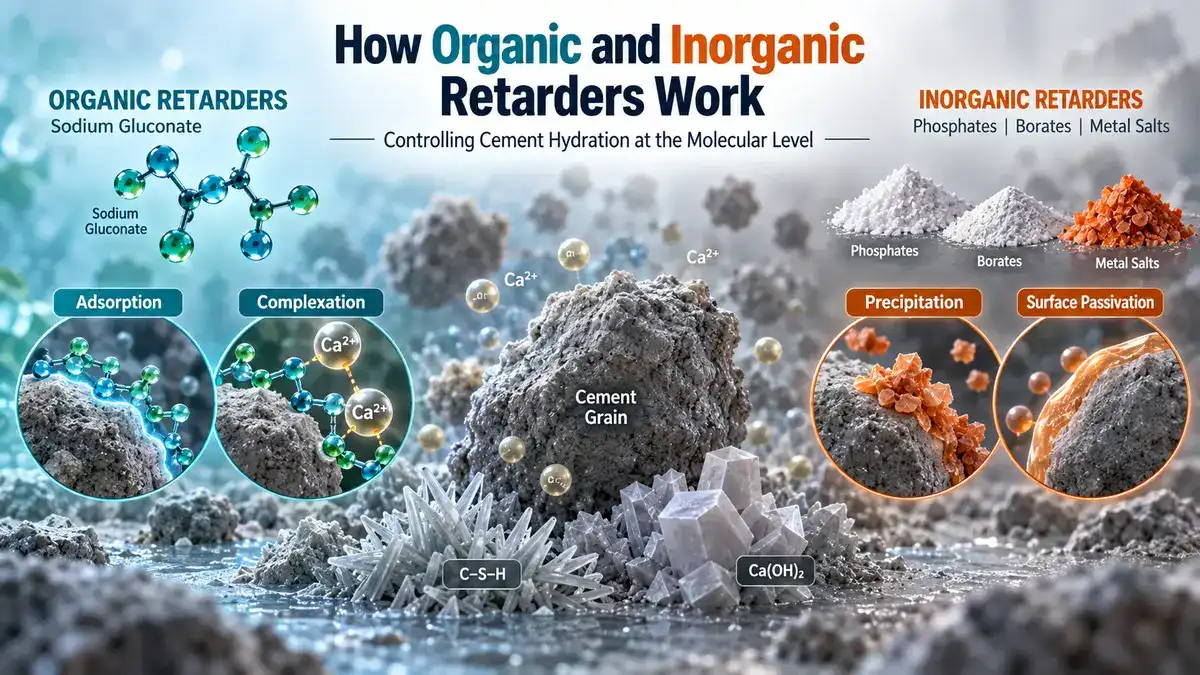
Depending on the retarder chemistry, mechanisms may include adsorption onto cement particles, complexation of calcium ions, inhibition of nucleation and growth of hydration products, or formation of temporary surface layers.
The result is an extended dormant period before rapid hydration and strength development begin.
Importantly, the effect of a retarder cannot be evaluated independently from the concrete system.
Cement mineralogy, sulfate balance, alkali content, supplementary cementitious materials, temperature and other admixtures can all influence setting behavior.
For this reason, standards such as ASTM C494 recommend performance testing using representative concrete materials whenever practicable.
What Are Organic Concrete Retarders?
Organic retarders contain carbon-based functional groups capable of interacting with cement hydration products.
Common examples include:
sodium gluconate, lignosulfonates, citric acid and citrate salts, tartaric acid derivatives, sugars and other carbohydrate-based compounds.
Among these materials, sodium gluconate (CAS 527-07-1) is widely used in concrete admixture formulations because relatively small quantities can significantly influence setting behavior.
Sodium gluconate is commonly produced from glucose and contains multiple hydroxyl groups together with a carboxylate group. These functional groups allow it to interact with calcium and other ions in cement pore solution.
Rather than describing its mechanism simply as “chelating calcium,” it is more accurate to understand retardation as a combination of adsorption, complexation and interference with the formation of early hydration products.
Advantages of Organic Retarders
Properly formulated organic retarders can offer several practical advantages.
They are effective at relatively low dosage levels, can be incorporated into modern water-reducing admixture systems and provide useful control over setting time in ready-mix and hot-weather Applications.
Sodium gluconate is particularly attractive to formulators because it is highly water-soluble and can be combined with different admixture technologies.
However, dosage must still be controlled carefully. Excessive amounts of sodium gluconate, sugars, citrates or other organic retarders can cause excessive setting delay.
There is therefore no technically sound basis for assuming that an organic retarder is automatically “safe from over-retardation.”
What Are Inorganic Concrete Retarders?
Inorganic retarding chemicals include selected phosphates, polyphosphates, borates, zinc compounds and other mineral-based salts.
Their mechanisms vary considerably.
Some inorganic species affect cement hydration by reacting with calcium ions, while others can form temporary precipitates or surface layers that slow the dissolution or hydration of cement phases.
This category is therefore much more chemically diverse than the term “inorganic retarder” may suggest.
Inorganic retarders can be effective in specific cementitious formulations, specialty binders and controlled industrial applications.
Their suitability must be evaluated individually rather than assuming that all inorganic materials behave in the same way.
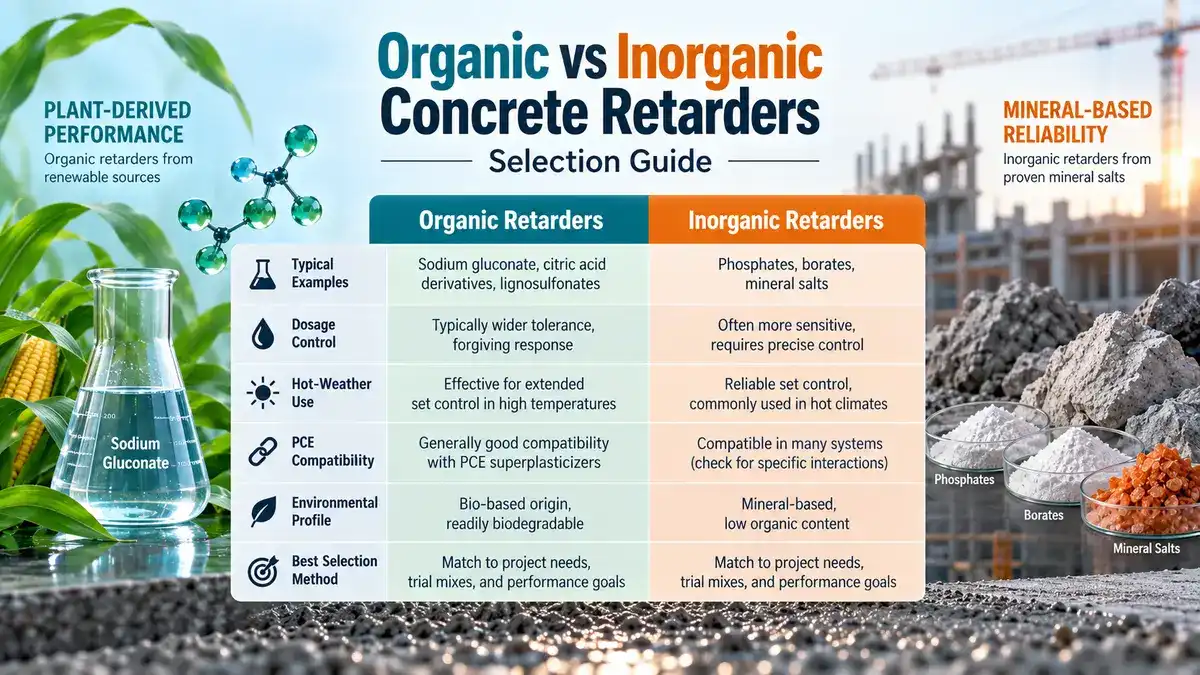
Organic vs. Inorganic Concrete Retarders: Key Differences
| Selection Factor | Organic Retarders | Inorganic Retarders |
|---|---|---|
| Typical examples | Sodium gluconate, lignosulfonates, citrates, carbohydrate derivatives | Phosphates, polyphosphates, borates, selected zinc compounds |
| Main hydration interaction | Adsorption, complexation and inhibition of early hydration product formation | Ion reactions, precipitation or surface passivation depending on chemistry |
| Dosage | Often effective at relatively low dosages | Strongly chemistry-dependent |
| Over-retardation | Possible if overdosed | Possible and can be significant with some chemistries |
| Hot-weather applications | Widely used in commercial retarding formulations | Application depends on individual chemistry and formulation |
| PCE systems | Frequently used, but compatibility testing is still required | Compatibility must be verified experimentally |
| Environmental profile | Depends on individual substance; some, including sodium gluconate, have favorable biodegradation profiles | Varies significantly between individual substances |
| Cost | Depends on dosage, grade, origin and formulation | Depends on material and application |
| Best selection method | Trial testing with actual cement and admixture system | Trial testing with actual cement and admixture system |
The biggest purchasing mistake is therefore to compare organic and inorganic retarders only by price per kilogram.
A technically useful comparison should consider cost per cubic meter of concrete, required dosage, setting-time stability, compatibility and production risk.
How Temperature Affects Concrete Retarder Performance
Temperature is one of the most important variables in retarder selection.
As concrete temperature increases, cement hydration generally accelerates. This shortens setting time and can increase slump loss during transportation and placement.
This is why retarding admixtures are widely used in regions such as the Middle East, Southeast Asia, Africa and Latin America during hot-weather construction.
Sodium gluconate is commonly used as a component in hot-weather retarding and slump-retention formulations.
However, it would be misleading to state that one fixed dosage will always produce the same number of hours of retardation at a particular temperature.
The result depends on the cement source, C3A content, sulfate balance, supplementary cementitious materials, water-to-binder ratio and interaction with other admixtures.
A dosage that performs well with one cement may behave differently after the cement supplier changes.
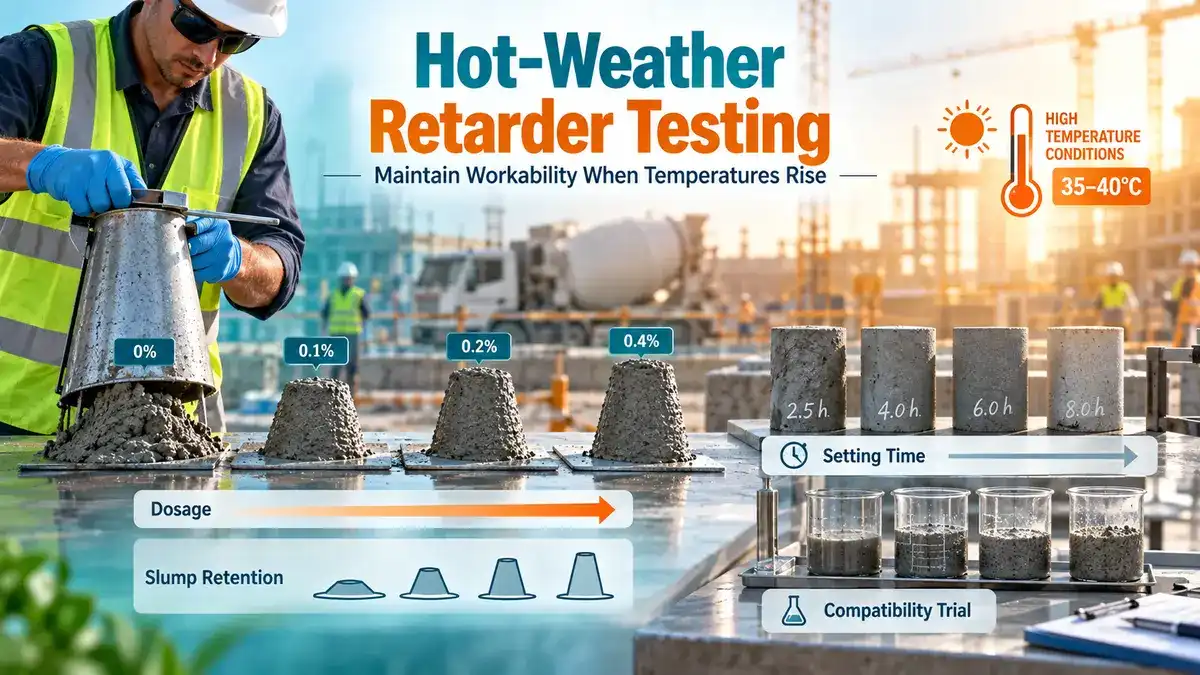
For hot-weather projects, laboratory trials should therefore reproduce the expected concrete temperature and transportation period as closely as possible.
Compatibility with PCE Superplasticizers
Compatibility with PCE polycarboxylate superplasticizers is particularly important in modern concrete formulations.
PCE systems are sensitive to cement chemistry, sulfate balance and admixture combinations.
Sodium gluconate is frequently incorporated into formulations that require both water reduction and extended workability, but its dosage should be optimized together with the PCE rather than evaluated independently.
Adding more retarder does not necessarily produce better slump retention.
Excessive retardation may delay finishing, formwork turnover or early-strength development.
For commercial formulation work, the recommended approach is to compare several dosage levels and measure:
initial slump or flow, slump retention, initial and final setting time, air content where relevant, early-age compressive strength and 28-day compressive strength.
This produces much more useful information than relying on a theoretical dosage alone.

Environmental and Regulatory Considerations
Environmental performance should also be evaluated substance by substance rather than simply dividing retarders into “organic” and “inorganic” categories.
Sodium gluconate has a favorable environmental profile and is considered readily biodegradable in environmental assessments.
It is also used beyond construction as a sequestrant and chelating agent in industrial and food-related applications.
In the United States, sodium gluconate is listed under 21 CFR 182.6757 as generally recognized as safe when used in accordance with good manufacturing practice.
This food-related regulatory status, however, should not be confused with concrete admixture compliance.
Likewise, ASTM C494 and EN 934-2 evaluate the performance or conformity of concrete admixtures. A sodium gluconate raw material should not automatically be described as “ASTM C494 certified” merely because it can be used as an ingredient in a retarding admixture.
For export procurement, buyers should instead review the documentation relevant to the specific material and application, including TDS, SDS, batch COA, quality-management documentation and applicable regulatory information.
When Should You Choose an Organic Retarder?
Organic retarders are often considered when a formulation requires extended concrete workability, controlled setting in warm conditions, integration with water-reducing admixtures or flexible dosage adjustment.
Sodium gluconate can be particularly useful for ready-mix concrete, infrastructure concrete, mass pours and admixture formulations where set control and workability retention must be balanced.
That does not mean an organic system should automatically be selected for every project.
The final decision should be based on concrete testing.
When Can an Inorganic Retarder Be Appropriate?
Inorganic retarders can be appropriate where a particular phosphate, borate or metal-salt chemistry has already been validated for the cementitious system.
They may also be useful in specialty binder formulations and industrial applications where their specific reaction mechanisms provide the required performance.
Because the category covers chemically different substances, there is no meaningful universal statement that inorganic retarders are always cheaper, faster or less environmentally acceptable than organic materials.
Individual products must be evaluated on their own technical and commercial merits.
How to Select the Right Concrete Retarder Chemical
For procurement teams and admixture formulators, a practical selection process begins with the required concrete performance rather than the chemical name.
First determine the target working time and setting-time extension.
Then evaluate the expected concrete temperature, transportation time, cement source, supplementary cementitious materials and other admixtures in the formulation.
Candidate retarders should then be tested at several dosage levels using the actual cement whenever possible.
The final comparison should consider not only raw-material price but also dosage efficiency, consistency, compatibility, strength development and the risk of rejected concrete batches.
This approach is especially important when changing suppliers or exporting an admixture formulation to a new country where the cement chemistry may be different.
EverStar Group Sodium Gluconate for Concrete Admixture Formulation
EverStar Group supplies sodium gluconate powder (CAS 527-07-1) for concrete admixture manufacturers, ready-mix applications and industrial formulations.
Typical commercial grades are available with high purity and controlled chloride, sulfate and moisture specifications.
For concrete customers, we recommend evaluating sodium gluconate with the actual local cement and PCE formulation before full-scale production.
Technical documentation including TDS, SDS and batch-specific COA can be supplied for product evaluation.
Customers developing new formulations can also request samples for compatibility and dosage testing.
For projects requiring a finished retarding admixture rather than sodium gluconate raw material, performance should be evaluated according to the applicable concrete admixture specification and project requirements.
Conclusion: Organic or Inorganic — Which Is Better?
There is no universal winner.
Organic retarders such as sodium gluconate are widely used because they provide powerful set-control capability and can be integrated into many modern concrete admixture formulations.
Inorganic retarders also remain technically useful for specific cementitious systems and specialty applications.
The best concrete retarder chemical is therefore not simply the one described as organic or inorganic.
It is the one that achieves the required setting time, workability and strength development with the actual cement, temperature and admixture system used in the project.
For new formulations, compatibility testing should always come before large-scale purchasing.
FAQ
1. What is the difference between organic and inorganic concrete retarders?
Organic retarders include materials such as sodium gluconate, lignosulfonates and hydroxycarboxylic acids. Inorganic retarders include phosphates, borates and selected metal salts. They interact with cement hydration through different chemical mechanisms, but actual performance depends heavily on the complete concrete formulation.
2. Is sodium gluconate a good concrete retarder?
Yes. Sodium gluconate is widely used as a set-control component in concrete admixture formulations. It is effective at relatively low dosage levels, highly water-soluble and suitable for applications where extended working time is required. The optimum dosage should always be established through testing with the actual cement.
3. Can sodium gluconate be used with PCE superplasticizers?
Sodium gluconate is frequently used in formulations containing PCE superplasticizers, especially when additional set control or workability retention is required. However, cement–PCE–retarder compatibility should be tested because performance can change with cement chemistry and dosage.
4. Which concrete retarder is best for hot weather?
There is no single retarder or fixed dosage that is best for every hot-weather concrete mix. Sodium gluconate-based systems are widely used in hot-weather applications, but the optimum formulation depends on concrete temperature, cement composition, required transportation time and other admixtures.
5. Can excessive concrete retarder delay strength development?
Yes. Excessive dosage of either organic or inorganic retarders can produce excessive setting delay and may reduce early-age strength development. This is why laboratory trials and accurate batching are important.
6. Does ASTM C494 apply directly to sodium gluconate powder?
ASTM C494 applies to chemical admixtures used in hydraulic-cement concrete and evaluates performance such as setting time and strength. Sodium gluconate can be an ingredient in a retarding admixture, but a raw sodium gluconate product should not automatically be described as ASTM C494 compliant without appropriate admixture-level testing.
References
1. ASTM International. ASTM C494/C494M-24, Standard Specification for Chemical Admixtures for Concrete.
2. European Committee for Standardization. EN 934-2:2009+A1:2012, Admixtures for Concrete, Mortar and Grout — Part 2: Concrete Admixtures.
3. Ramachandran, V.S. Concrete Admixtures Handbook: Properties, Science and Technology. Second Edition.
4. Taylor, H.F.W. Cement Chemistry. Second Edition.
5. U.S. Environmental Protection Agency. D-Gluconic Acid, Sodium Salt (Sodium Gluconate) chemical assessment information.
6. U.S. Food and Drug Administration. Sodium Gluconate, 21 CFR 182.6757.
Request Sodium Gluconate Samples or Technical Documentation
EverStar Group supplies sodium gluconate and concrete admixture materials for international B2B customers.
For product specifications, TDS, SDS, COA, samples or current commercial quotations, contact:
Email: info@cneverstar.com
EverStar Group — Concrete Admixture Materials for Global Supply
How concrete Set Retarders work ?